



Remoras, commonly known as suckerfish, are not always the most respectful travel buddies. These small fish hitch rides by clinging onto larger sea creatures like sharks, whales, and manta rays, feeding on parasites in return for the transportation.
While this symbiotic relationship seems beneficial, recent findings suggest that manta rays might face challenges when accompanied by remoras.
Emily Yeager, a marine researcher at the University of Miami, explained to As It Happens host Nil Kӧksal that these fish exhibit a peculiar behavior of entering manta ray cloacas, a shared orifice for reproduction and waste expulsion. This behavior, termed “cloacal diving,” was detailed in a study authored by Yeager and published in the journal Ecology and Evolution.
The Phenomenon of ‘Cloacal Diving’
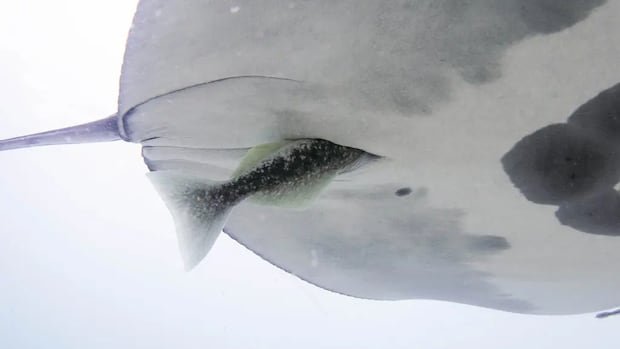
The act of “cloacal diving” involves the remora plunging into the cloaca of the manta ray, a behavior previously observed with whale sharks but now documented for the first time with rays. Researchers have recorded seven instances of this behavior over a 15-year period, suggesting it may occur more frequently than reported.
Yeager speculated that this behavior might stem from fear reactions in remoras, as witnessed in a video where a startled remora swiftly dives into a manta ray’s cloaca, causing the ray to shudder before continuing its journey.

Remoras, also known as suckerfish, are well-known for hitching rides on large marine animals like sharks and manta rays. But a new study observes the little fish getting a little more intimate — and diving straight into the manta ray’s rear-end orifice. Credit: Bryant Turffs/Marine Megafauna Foundation.
Brooke Flammang, a biological sciences professor at the New Jersey Institute of Technology, suggested that the remoras’ behavior might be linked to seeking food, a phenomenon known as coprophagy or eating feces.
- <a class="similarLink" href="https://www.cbc.ca/radio/asithappens/chimpanzee-grass-b