

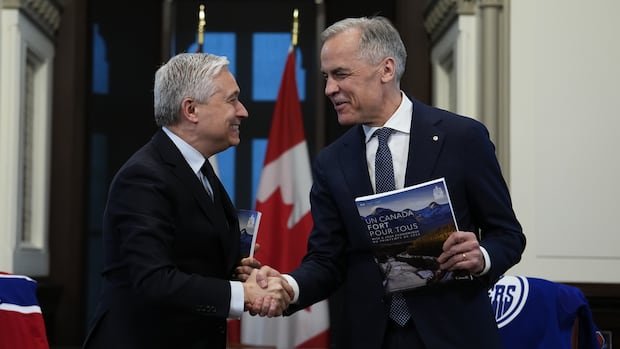

Despite being talkative by nature, the finance minister wasted little time on Tuesday to share some positive news.
François-Philippe Champagne informed the House of Commons during the federal government’s spring economic and fiscal update that Canadians expect responsible management of the economy and public finances with prudent fiscal discipline.
He proudly stated that Canada has achieved the second-fastest-growing economy in the G7, along with decreasing the projected deficit for 2025-26 by over $11 billion.
The Liberals present in the House applauded his remarks.
Champagne emphasized that their achievements reflect strong fiscal management while receiving mocking reactions from the Conservatives.
When Conservative Leader Pierre Poilievre took the floor, he criticized that the current deficit is twice as high as projected under the previous government. He labeled the spring update as another instance of reckless “credit card budgeting.”
Poilievre accused the prime minister of being no different from previous Liberals.
This ongoing debate on federal fiscal policy spans over 11 years, with the current deficit for the 2025-26 fiscal year reduced from $78.3 billion to $66.9 billion compared to last fall’s budget projections, showcasing Champagne’s commitment to fiscal discipline.
The Conservatives, however, are more focused on the current fiscal year and the previous finance minister’s deficit projections.
During the fall of 2024, the government projected a deficit of $31 billion for 2026-27, a figure the Conservatives believe should have been adhered to. In contrast, the spring update lowered the deficit marginally to $65.3 billion from the previous projection of $65.4 billion.
These differing perspectives were evident during the House proceedings on Tuesday.
Key Highlights of the Spring Update
The spring update largely avoided debate on its fundamental components.
The most significant expense is the increased GST credit, now termed as the groceries and essential benefit, which will raise federal expenses by $11.8 billion over six years.
Additionally, a temporary halt in federal excise taxes on gas and diesel will cost $2.4 billion, while the government allocated $6 billion over five years to enhance skilled trades. There are also new allocations for student loans and small craft harbors.
Poilievre criticized the government’s spending on climate initiatives but mainly focused on the substantial numbers. He highlighted that interest charges on federal debt this year will surpass $59 billion, surpassing federal transfers to provinces for health care and GST collections.
Beyond the current fiscal year, Champagne projects a gradual decline in annual deficits to $63.1 billion, $57.7 billion, $56.2 billion, and $53.2 billion. The federal government defends its deficit spending by comparing favorably to other G7 countries’ fiscal positions and emphasizing the shift towards capital spending over operational expenses to stimulate economic growth.
The impact of operational cuts and the effectiveness of capital spending remain uncertain, with the Conservatives criticizing the excessive Liberal spending and the risk of wastefulness with deficit running governments.
Although the Conservatives question the budget balancing approach, projecting deficits in their platform, it raises the question of whether the parties are only disputing a relatively small amount.
Discussion on Potential GST Increase
The current deficit stands at