


A deteriorating air leak on the International Space Station (ISS) led five astronauts to seek refuge and prepare for potential evacuation for around two hours on Friday as Russia worked to address a crack on its segment of the space station, as per information from NASA.
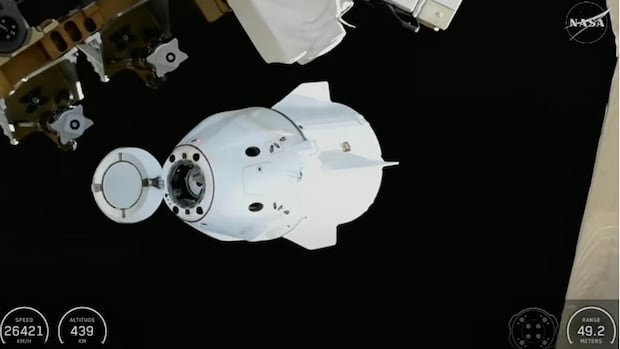
The four Crew-12 mission astronauts — two American astronauts, a French astronaut, and a Russian cosmonaut — alongside another U.S. astronaut, were directed by NASA mission control at 9:04 a.m. ET on Friday to enter their SpaceX-built Crew Dragon spacecraft attached to the station, stated NASA spokesperson Bethany Stevens.
After approximately two hours, NASA rescinded the order and allowed the astronauts to return to the station while both NASA and its Russian counterparts assessed the air leak rate.
NASA and Russia’s space agency, Roscosmos, the primary operators of the station, have been in discussions for months regarding the cause and potential solutions for minor air leaks on Russia’s Zvezda service module, a critical component of the ISS where astronauts reside and conduct experiments in space.
According to Chris Cassidy, the former NASA chief astronaut who led Expedition 63 on the ISS in 2020, the leak was initially identified during that mission. Cassidy mentioned that efforts have been ongoing for several years to address the leak issue, which has proven to be challenging.
Roscosmos reported on Friday that its experts identified two leaks on the ISS but assured that there was no immediate danger to the crew.
The initial leak was swiftly sealed, and plans were underway to address the second one, as per Roscosmos, who stated that the spacecraft’s systems were not at risk.
While air leaks have been minor in recent months, the rate escalated on Friday from one pound of air per day to two pounds, according to a senior NASA official. This sudden increase in leakage rate raised concerns about the timeframe available before triggering alarm levels due to atmospheric loss.
The ISS currently houses seven astronauts from two missions, including the Crew-12 team and another crew that arrived in November.
Efforts were being made by two cosmonauts, Sergey Kud-Sverchkov and Sergei Mikayev, to access and repair the leaking crack, although NASA officials disagreed with their approach. This disagreement led to Houston mission control ordering safe-haven procedures for the astronauts.
Safe-haven orders on the ISS are infrequent, typically prompted by potential collisions with space debris or significant changes in air leak rates. The astronauts have never evacuated the ISS in its 27-year history.
The U.S. Congress is considering legislation to extend the ISS’s operational life until 2032 to allow more time for developing a replacement. The bill is supported by Senators Ted Cruz and Maria Cantwell and aims to counter China’s expanding space capabilities.
Negotiations are ongoing in Congress to finalize the proposed legislation.