

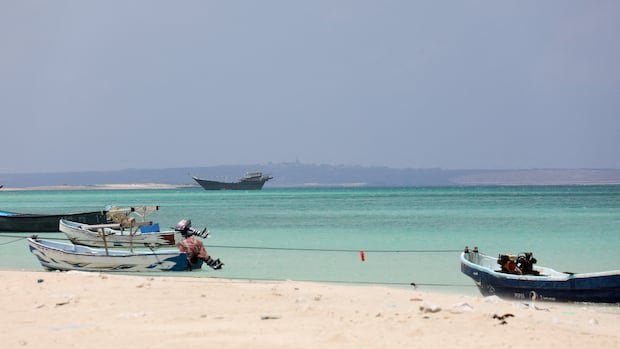

Yemeni officials reported that six individuals lost their lives on Tuesday due to an assault by Iran-backed Houthi rebels targeting a ship in the Bab el-Mandeb strait. The casualties comprised four crew members and two individuals from the government-allied National Resistance Forces. According to Yemen’s Transportation Ministry, the Houthis launched three ballistic missiles at the Yemeni commercial vessel, marking the first fatalities from Houthi attacks on maritime vessels in Yemen during the recent conflict.
Following the effective closure of the Strait of Hormuz by Iran, attention has shifted to the Red Sea and the Bab el-Mandeb Strait at the southern tip of Yemen, which serves as an alternative route for Saudi Arabia to transport its oil. The Houthis also launched assaults on the government-controlled port city of Mokha on the Red Sea and other regions within the country.
Yemen’s military disclosed that the rebels targeted Mokha and the central province of Marib using missiles and drones but did not provide further specifics. Recent Houthi attacks in Marib and the eastern province of Hadramout resulted in numerous casualties among government forces and civilians. In Mokha, at least seven individuals, including three troops, were killed in missile and drone strikes over the weekend.
The Houthis’ actions signify an escalation against Yemeni government forces and oil installations in Saudi Arabia. These attacks have the potential to reignite the civil war in Yemen post the 2022 truce and introduce a new conflict in the Middle East.
Mohammed Abdul-Salam, the chief negotiator and spokesperson for the Houthis, accused Saudi Arabia of exploiting the ceasefire to tighten the blockade it initiated in 2015. He emphasized the Houthis’ readiness for negotiations but insisted that any resolution must involve lifting the blockade. Contrary to these claims, Riyadh denied besieging Yemen.
On a different note, Iranian Foreign Minister Abbas Araghchi highlighted Tehran’s demands, emphasizing Iran’s resilience against the U.S. and Israel. Iran has maintained its stance on the prerequisites for reopening the Strait of Hormuz, including the end of the U.S. blockade of Iranian ports and the removal of sanctions. The closure of this crucial waterway, through which a significant portion of global oil trade passes, has major implications for energy prices and remains a focal point in U.S. political discourse ahead of the upcoming midterm elections. U.S. President Donald Trump recently commented on the impact of the U.S. Navy’s blockade on Iran’s economy, stating that despite their ability to cause disruptions, Iran is facing financial challenges.