


Experts in finance anticipate that the upcoming spring economic update on Tuesday will introduce new economic measures aimed at addressing affordability issues and broader economic challenges facing the nation. They also predict that the update will reveal a deficit lower than previously forecasted, which is expected to draw significant attention.
Sahir Khan, the executive vice president of the Institute of Fiscal Studies and Democracy at the University of Ottawa, highlighted that government revenues are likely on the rise due to a more resilient economy than anticipated and surging oil prices. Additionally, delays in disbursing promised funds have contributed to a reduced deficit figure.
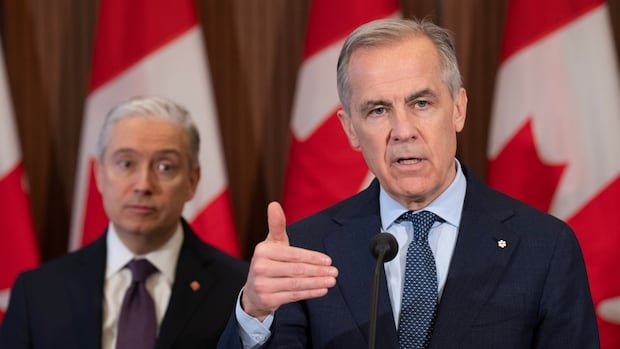
During a news conference on Monday, Prime Minister Mark Carney emphasized the government’s commitment to fiscal responsibility, stating, “We were determined to reduce spending through some tough decisions. You can’t tackle everything simultaneously.”
In the budget released in November, the deficit projection for the recently concluded fiscal year was $78.3 billion. However, a recent Department of Finance report indicated a deficit of $25.5 billion between April 2025 and February 2026, well below the initial forecast with only one month left. The budget also projected a deficit of $65.4 billion for the following year, 2026-27.
The leader of the opposition is likely to find any deficit figure presented in the Tuesday update unsatisfactory. Conservative Leader Pierre Poilievre expressed his opinion that there should be no deficit, criticizing the Liberal government for making it unattainable this year.
Poilievre cautioned that the deficit numbers from April to February do not reflect the complete picture, anticipating a surge in spending in March. He criticized the government’s spending practices and compared it unfavorably to previous administrations.
Looking Beyond the Deficit
Economists emphasize that the deficit is just one indicator of the country’s economic health. Many are keen to assess business confidence and investment in the upcoming update, as these factors are crucial markers as well.
Dawn Desjardins, the chief economist at Deloitte, highlighted concerns over business apprehension about the economy’s future trajectory, leading to reduced spending. She stressed the importance of these metrics alongside the deficit.
Desjardins acknowledged the government’s efforts to diversify trade relationships but noted that the results of such initiatives take time to materialize. She also pointed out the heightened global volatility due to recent geopolitical tensions.
Experts hope the spring update will provide transparency on the progress of various projects, measures, and deals announced over the past year. The focus is on ensuring that these initiatives are effectively implemented for the benefit of Canadian households.
Furthermore, stakeholders are urging the government not to overlook outstanding financial commitments and promises. Groups like the Centre for Israel and Jewish Affairs are calling for the government to fulfill previous pledges, such as enhancing the Canada Community Security Program.
Finance Minister François-Philippe Champagne framed the upcoming economic update as a continuation of the government’s long-term objectives outlined in the budget, emphasizing the commitment to enhancing affordability for Canadians.