

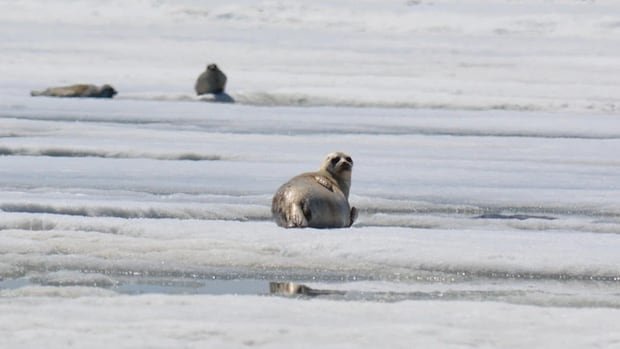

Ringed seals in Hudson Bay display a willingness to take risks, including the threat of becoming prey themselves, in pursuit of a diverse food selection. A recent study published in Ecology Letters examined the dynamic between these seals and polar bears, suggesting that this relationship is crucial in the establishment of marine protected areas.
Researchers, led by Katie Florko, a research scientist at the University of British Columbia, found that while seals typically avoid areas with polar bears, they might venture into high-risk zones for abundant or diverse food sources. The study, which involved tagging 26 seals with satellite telemetry transmitters near the Belcher Islands in Nunavut, tracked their movements and dives. Additionally, GPS collars on 39 polar bears provided data on over 18,000 locations, helping researchers identify areas with heightened predation risks for the seals.
The study revealed that seals reduced their diving duration in high-risk areas, possibly to allow time to escape to alternative breathing holes if a polar bear was detected. The researchers emphasized the importance of incorporating both food availability for seals and pressure from polar bears when designing protected areas to avoid inadvertently protecting areas already avoided by seals.
Climate change poses significant challenges to these predator-prey relationships in the Arctic, with implications such as polar bears concentrating in smaller ice areas and shifts in fish distribution. While the study represents a positive step towards understanding the constraints on seal distribution, Brendan Kelly from the International Arctic Research Center at the University of Alaska Fairbanks notes some reservations. Despite some concerns, the research contributes valuable insights despite the complexities involved in managing Arctic wildlife effectively.