

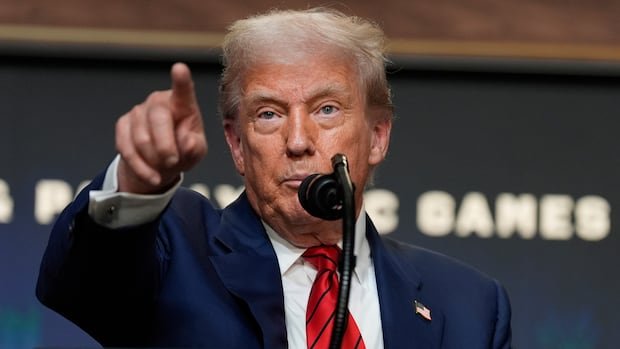

President Donald Trump has made it clear that the restructuring of electoral districts in Texas is a strategic move to benefit the Republican Party in the upcoming 2026 midterms.
Trump is supporting Texas Governor Greg Abbott and other Republican lawmakers in their efforts to alter the election map, potentially flipping up to five seats in the U.S. House of Representatives from Democrats to Republicans.
In an interview with CNBC on Tuesday, Trump expressed optimism about the chance to gain five additional seats in Texas for the Republican Party.
Democratic state representatives have left Texas to prevent the Republicans from achieving a quorum in the legislature to approve the new boundaries, risking fines, arrests, and possible removal from office.
Here’s a breakdown of the situation:
Why is the Texas redistricting significant?
The configuration of U.S. congressional districts plays a crucial role in determining which party holds the majority in the House of Representatives.
With the Republicans currently holding a slim majority in the House, the midterm elections historically result in the president’s party losing seats. If Democrats take control in 2026, it could impede Trump’s legislative agenda and potentially lead to impeachment.
Changing the Texas map to shift Democratic seats to Republican could help maintain Republican control of the House.
Why do states have control over district maps?
In contrast to Canada, where non-partisan commissions redraw federal riding boundaries, U.S. Congressional district maps are controlled by partisan state legislatures. This practice has led to a history of gerrymandering, where the party in power manipulates boundaries to maximize its seat count.
While some states have shifted redistricting responsibilities to independent commissions, many continue to have partisan control over the process.
How would new boundaries in Texas impact the political landscape?
In the 2024 elections, Republicans won 25 House races in Texas, while Democrats secured 13. The proposed redistricting could potentially shift up to five Democrat-held seats to the Republicans based on recent voting trends.
The changes involve consolidating Democratic strongholds in urban areas and adjusting boundaries in south Texas to favor Republican candidates.
Why is there little opposition to such partisan redistricting?
Although the U.S. Constitution grants states authority over election boundaries, legal rulings have allowed states to engage in politically motivated redistricting. The U.S. Supreme Court’s 2019 decision deemed partisan gerrymandering as beyond federal court jurisdiction, permitting states to draw maps for partisan advantage.
Republican lawmakers like Brian Harrison justify the practice by pointing out that both parties engage in gerrymandering and argue that Texas should do the same to level the playing field.
Why did Democratic legislators leave the state?
To thwart the legislative efforts to approve new boundaries, Democrat representatives left Texas to prevent a quorum from being met. The lawmakers dispersed to Democrat-controlled states to avoid potential legal repercussions from Texas authorities.
Can politicians face consequences for not attending legislative sessions?
Speaker of the House in Texas authorized the arrest of absent Democrat representatives, though the warrants are only enforceable within state lines. While legislators could incur fines for each day of absence, there are no criminal charges pending. However, Governor Abbott has hinted at bribery charges if fines are paid through donations, and some Republicans are exploring options to remove the Democrats from office.
What is Trump’s stance on gerrymandering?
Trump justifies the Republicans’ push for additional seats in Texas by claiming entitlement based on election results and accusing Democrats of gerrymandering in their states. However, historical data contradicts Trump’s assertions regarding election outcomes in Texas.
The president’s comments have sparked debates on the legality and ethics of partisan-driven redistricting.
What lies ahead?
There are warnings from Democratic-leaning states like California about potential counteractions in response to Texas’ redistricting plans. Legal challenges may arise if the new map is confirmed, but the 2019 Supreme Court ruling on partisan gerrymandering could complicate the legal landscape.