

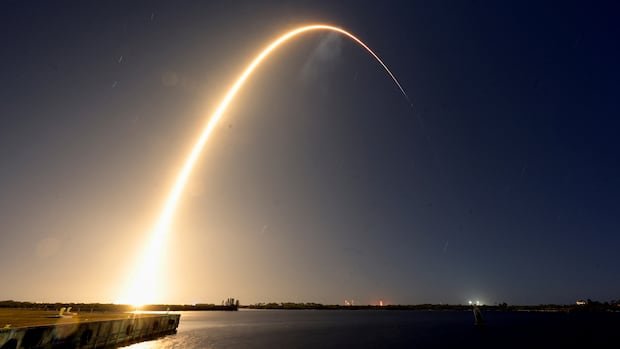

A SpaceX spacecraft that carried two lunar landers crashed into the moon on Wednesday as expected after veering off course for the past year, scientists confirmed. While the actual collision at a speed of 8,700 km/h was not witnessed, a debris plume resulting from the impact was observed by a telescope in Chile, according to astronomers.
This incident highlights the ongoing issue of space debris on the moon, a concern that may escalate as the United States and China compete to land astronauts on the lunar surface. In a similar event in 2022, a Chinese rocket accidentally struck the moon during a lunar mission, with potentially more stray rocket components hitting the moon over the years unbeknownst to scientists.
SpaceX’s Julianna Scheiman stated that the company is collaborating with NASA to prevent future collisions, emphasizing that this particular crash was unintentional. She explained that a combination of solar activity and gravitational forces led to the spacecraft being on a collision course with the moon.
Boston University’s Carl Schmidt expressed certainty that his team’s observations confirmed the lunar impact. The European Southern Observatory’s Very Large Telescope detected a trail of sodium and lithium extending into space for several kilometers after the crash. Despite lacking direct images of the impact, Schmidt emphasized the telescope evidence.
Retired astrophysicist Jonathan McDowell noted earlier that observations indicated the rocket’s upper stage was heading directly for the moon. The expected crash location was near the Einstein Crater on the moon’s sunlit western limb, a challenging area for Earth-based observation.
Observers anticipated that visual confirmation of the crash would be challenging from the ground. Orbiting spacecraft had a better chance of observing the impact or the resulting crater post-impact. Dutch scientist Marco Langbroek attempted to view the event with his telescope but did not witness it, acknowledging the slim chances of success.
McDowell mentioned that confirmation through visual evidence would likely come from NASA’s Lunar Reconnaissance Orbiter in the following week. The Falcon rocket’s upper stage, which carried two lunar landers, ultimately drifted off course after a successful launch from Cape Canaveral, Florida, on January 15, 2025.
The moon has become a prime destination for space exploration, with plans for a significant increase in robotic missions to establish a sustainable lunar base. Private companies like SpaceX and Blue Origin are set to provide lunar landers for NASA’s Artemis missions, with potential crewed landings as early as 2028.
McDowell warned of increased activity near the moon in the coming years, emphasizing the need to address impacts like this one to prevent widespread dust disturbances on the lunar surface.
[End of rewritten article]