

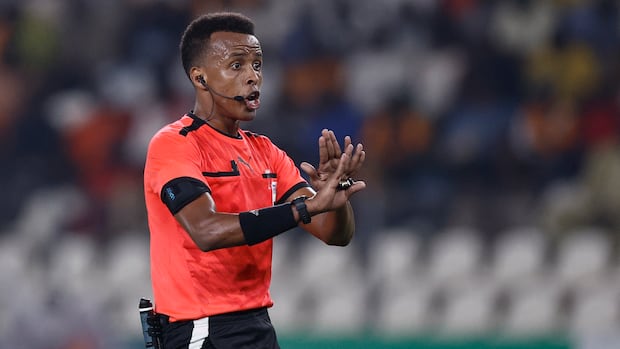

The World Cup referee from Somalia, who faced a denial of entry into the United States upon his arrival in Miami and was subsequently removed from the tournament by FIFA, was on the brink of making history for his nation.
Omar Artan was set to become the first Somali referee to officiate at a World Cup, having made it onto FIFA’s final roster for the event announced two months prior. He is recognized as one of the leading referees in Africa and was awarded the title of the continent’s best male referee in 2025.
On Saturday, he was barred from entering Miami International Airport due to “vetting concerns,” as stated by U.S. Customs and Border Protection, which did not elaborate on the specifics of these concerns. The Somalia Embassy in Kenya, which processed his visa, confirmed that he had received it just last week.
Andrew Giuliani, the executive director of the White House FIFA Task Force, stated on Tuesday that the referee’s denial of entry was based on “very good reason,” but he refrained from providing further details.
It is quite rare for a FIFA-appointed match official to be denied entry into a World Cup host nation. Artan was expected to join fellow World Cup referees at their training facility in Miami.
Somalia is among nearly 40 nations subjected to newly imposed travel limitations due to the Trump administration’s strict immigration policies. This has raised concerns that fans, players, and officials from these predominantly African nations could be impacted by the crackdown and be denied entry for the World Cup, despite possessing valid visas.
Artan has been lauded as one of Africa’s finest referees and officiated the crucial leg of last month’s African Champions League final, the continent’s premier club soccer event.
In a recent interview with Al Jazeera, he expressed his honor at being chosen as the first Somali referee for the World Cup, detailing the obstacles he has faced in his war-torn homeland, including the need to change his training routes due to explosions in the capital city of Mogadishu.
“As a referee, you cannot give up,” Artan remarked during the interview. “Attending the World Cup was my ultimate goal, and I am genuinely thrilled.”
Interrogated for hours at the airport
Artan recounted to The New York Times that he was questioned for 11 hours upon his arrival at Miami airport by border officials, who inquired about his reasons for traveling to the U.S. and probed him about Somali politics and the al-Shabab militant organization involved in an insurgency against the government. He presented FIFA documentation and photographs from his refereeing career, he stated.
Following the interrogation, he was placed in a holding cell and subsequently returned on a flight to Istanbul, Turkey, from where he had made his connecting journey to the U.S.
“I believe they have issues with my country,” Artan told The New York Times, noting that he possessed the appropriate documents and visa. He mentioned that he was not informed of the reasons for his entry denial, according to the Times.
The Somalia Youth and Sports Ministry announced on Tuesday that its embassy in the U.S. is actively working to resolve the issue in order to facilitate Artan’s participation in the World Cup, which is set to commence on Thursday.
Isse Aden Abshir, a senior advisor at the Somalia sports ministry, stated to The Associated Press that the refusal of entry for Artan may be tied to the broader travel restrictions on Somalia, “rather than any specific allegations against him.”
Subjected to ‘additional inspection’
Customs and Border Protection clarified in a statement on Monday that Artan “underwent additional inspection” upon his arrival, describing it as “a routine part of CBP’s inspection process when officers need to verify information or assess admissibility.”
“After the inspection, the traveler, a referee for the FIFA World Cup, was found inadmissible due to vetting concerns and was denied entry,” CBP indicated.
CBP affirmed that all individuals seeking entry into the U.S. — including World Cup players, coaches, and staff — are subject to inspection and vetting by CBP.
“Decisions regarding admissibility are made on an individual basis using available law enforcement, national security, and immigration information at the time of inspection,” the CBP statement explained. “CBP officers are authorized to question travelers, conduct inspections, and determine admissibility in accordance with U.S. law.”