

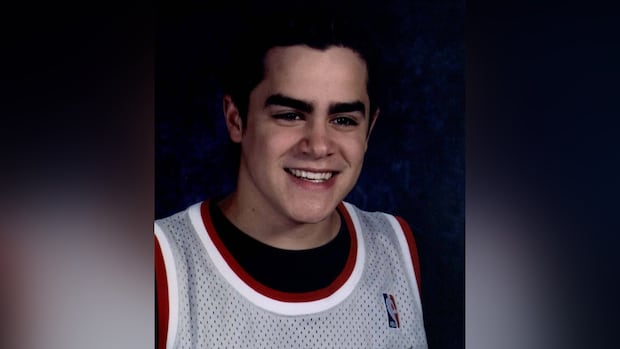

The individual responsible for the fatal stabbing of Misha Pavelick over two decades ago is set to be sentenced as a minor.
On May 21, 2006, Pavelick was just 19 when he was attacked during a graduation celebration at Kinookimaw Campground, located approximately 45 kilometers northwest of Regina Beach.
The convicted murderer is currently 37 years old, though he was only 17 when the stabbing occurred.
On Monday, Justice Catherine Dawson announced her decision to classify the sentencing under youth provisions at the Regina Court of King’s Bench. As a result, the man’s identity will remain confidential due to the Youth Criminal Justice Act.
Justice Dawson clarified that the Youth Criminal Justice Act assumes that young individuals have reduced moral culpability for their actions. For the court to impose an adult sentence, the prosecution must disprove this assumption beyond a reasonable doubt.
A Regina King’s Bench judge has reserved her ruling on whether the individual found guilty of second-degree murder in Misha Pavelick’s death will be sentenced as a youth or an adult. Justice Catherine Dawson is expected to announce her decision on May 26, over 20 years after Pavelick, then 19, was fatally stabbed at a Regina Beach campground.
Dawson indicated that the Crown did not meet the “heavy burden” necessary to satisfy the first part of a two-part evaluation regarding whether a young offender should be sentenced as an adult.
“I need to assess his personal growth at the time of the offense,” Dawson stated, focusing on the individual as he was at 17 rather than his current age of 37.
This created challenges, she noted, as her assessment could only reference past documentation related to other offenses committed by the young man, which included assaults and dangerous driving convictions.
The evidence and documents presented during the trial do not clearly indicate that the man was acting with adult maturity; instead, they suggest he displayed immaturity and irresponsibility, being influenced by peers and reliant on parental support, according to Dawson.
She explained that due to the Crown’s inability to fulfill the first part of the test, she could not proceed to the second part, which would evaluate if a youth sentence would appropriately hold him accountable for his criminal behavior.
Dawson acknowledged that if she were to consider the second part, it would be difficult to justify the maximum youth sentence of seven years for second-degree murder, which includes four years in custody followed by three years of supervision.
She postponed her decision regarding the length of the sentence until Tuesday and will also determine whether to credit the time spent in pre-sentence custody.
Crown prosecutor Adam Breker urged the judge to deny any credit to the man, arguing that his custody was a result of his own actions.
Breker detailed that the man had been granted bail by consent after charges were filed but subsequently failed to appear in court for the start of his preliminary hearing.
The hearing continued in his absence, and on the third day, he entered the courtroom as if everything was normal.
Following this, he was arrested and charged with failure to appear in court and assaulting a peace officer, Breker stated, with those charges still outstanding.
Breker implored the judge not to lessen the sentence, asserting that such a move would fail to acknowledge the seriousness of the crime.
Defense attorney Andrew Hitchcock countered, requesting that Dawson credit the man for one year, eight months, and 13 days spent in pre-sentence custody.
Dawson will also need to impose a mandatory DNA order and determine the duration of a weapon prohibition, which must last a minimum of two years following the custodial sentence.

A sentencing hearing is currently taking place at Regina King’s Bench for the 37-year-old man who fatally stabbed 19-year-old Misha Pavelick two decades ago, during his own teenage years. The Crown is advocating for an adult sentence.
In November 2025, a jury of 12 found the man guilty of second-degree murder after listening to testimonies from over 30 witnesses and reviewing evidence including photographs, DNA tests, and an autopsy report.
During the initial days of April, Breker and Hitchcock presented extensive arguments regarding sentencing, after which Dawson chose to reserve her judgment.
Since the verdict, the 37-year-old has been held in custody.
The prosecution has sought an adult sentence, which would entail a life imprisonment with no possibility of parole for a minimum of seven years, and would also make the man’s identity public for the first time.
Breker previously informed the court that, regardless of the judge’s ruling, the man would serve his sentence in an adult facility.
He added that a youth sentence would provide no actual benefit to the man in 2026, aside from a potentially shorter duration of incarceration.
Hitchcock contended that court documents illustrated the man had a tendency to be “unduly influenced by his peers” during his youth, and that expert testimony from a psychiatrist and psychologist indicated such behavior is more prevalent in adolescents than in adults.