


The prolonged ordeal of our national home renovation is coming to an end.
Or, at the very least, it is finally being recognized.
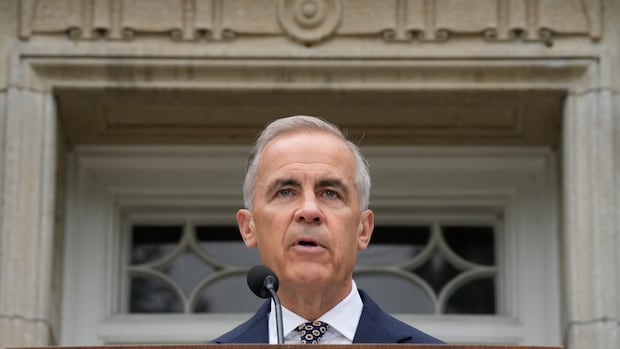
“Twenty-four Sussex Drive represents more than just a home; it stands as a testament to history. It embodies the public office of our federal government and reflects the democratic principles that this position upholds,” stated Prime Minister Mark Carney on Friday, while addressing a building that is presently uninhabitable.
The 19th-century residence, which has been home to every prime minister from Louis St. Laurent in 1951 to Stephen Harper in 2015, has welcomed numerous iconic figures from global history, including John F. Kennedy, Winston Churchill, and Queen Elizabeth II. Carney remarked that this residence “has not been treated with the reverence it truly deserves.”
“For years, there has been a consensus that 24 Sussex should be preserved, yet it has been allowed to deteriorate,” he added. “As a result, the damage has worsened, repair costs have surged, and the residence now finds itself in critical condition.”
-
Carney says donor list for 24 Sussex restoration will be public
-
State of 24 Sussex ‘an embarrassment,’ says Carney
-
Rideau Cottage ‘inadequate’ home for a PM as decision on 24 Sussex looms: internal memo
Consequently, Carney is suggesting a bold approach that his predecessors have avoided — initiating a design competition along with a fundraising campaign to reconstruct an official residence for Canada’s prime minister at this historic location.
While one could debate the specifics — the appeal for private contributions, even through a reputable organization like the Rideau Hall Foundation, might pose complex practical and political dilemmas — it could be generally accepted that the prime minister of Canada, who leads a G7 economy, ought to have an official residence. It seems that the circumstances have finally escalated to a point where action must be taken.
In fact, it could be argued that this point was reached long ago.
The Decline of 24 Sussex
The residence at 24 Sussex Drive — pleasant, yet never particularly remarkable — was reported to be in a “state of advanced disrepair” as early as 1984. In 2005, Rick Mercer visited the residence for an interview with Paul Martin, humorously highlighting the condition of the home — the comedian and the prime minister famously bought plastic sheeting at Canadian Tire and used hair dryers to secure it to the drafty back doors.
Just three years later, the auditor general reported that “many of the residence’s systems are nearing the end of their useful lives, are in poor condition, and will require replacement soon.” With a long list of issues identified, it was noted that fully addressing the necessary repairs would necessitate the prime minister temporarily vacating the premises for a period of at least 12 to 15 months.
Despite the inconvenience, the “ongoing delay in rehabilitating 24 Sussex Drive” would “result in several consequences,” including “further deterioration of this heritage property” and “an increase in rehabilitation costs.”
At that time, Prime Minister Stephen Harper opted not to confront the issue, and his successor, Justin Trudeau, chose to reside elsewhere entirely.
The most straightforward explanation for years of negligence is political dynamics.
Brian Mulroney allocated some funds for renovations in the 1980s, leading to a controversy dubbed “Gucci-gate” — which referenced the number of expensive shoes alleged to fit into one of the newly installed closets. None of his successors dared to undertake any actions that might provoke similar backlash.
In reality, Mulroney’s renovations were hardly the original issue — concerns regarding the costs of maintenance date back at least to 1953, just two years after St. Laurent took residence, when a Progressive Conservative MP expressed anxiety over an annual repair expenditure of $10,000.
Billions spent on unnecessary tax reductions or subsidies may seem abstract. However, the expenditure of thousands or millions on renovations for a home occupied by the prime minister is more tangible and relatable. (If the federal government had a dollar for every article and opinion piece written about 24 Sussex in the past two decades, a significant portion of the renovation costs would likely be covered.)
When asked on Thursday for his perspective on the future of 24 Sussex, Conservative Leader Pierre Poilievre expressed a complete lack of interest in contemplating it.
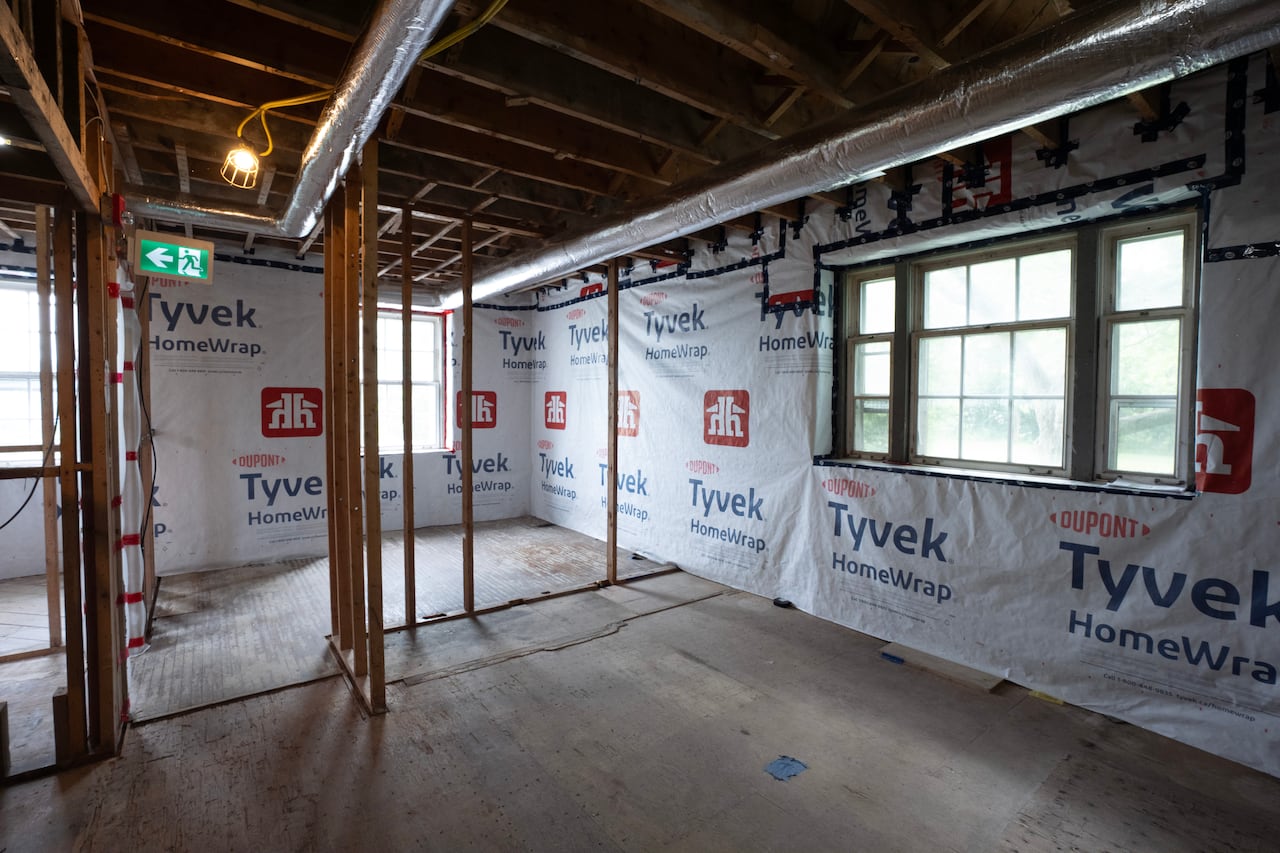
The interior of the official residence has been extensively stripped, requiring significant repairs. (Adrian Wyld/The Canadian Press)
“When I see the homelessness on our streets and observe young individuals eager to start families but unable to find suitable housing, I believe that 24 Sussex Drive should be the least of our concerns,” noted Poilievre, who has resided at Stornoway, the Opposition leader’s official residence, for nearly four years.
But is that really the choice? Is it unreasonable to hope that the federal government could prioritize both making housing more affordable and responsibly managing official residences? Should 24 Sussex remain untouched until all homelessness in Canada is eradicated?
(In 2019, the Conservatives claimed that the lack of action on 24 Sussex was a “failure” on Justin Trudeau’s part and that they would somehow resolve the “debacle” if they were to come into power.)
Even as Carney revealed a plan to address 24 Sussex, his proposed fundraising initiative appeared to be an effort to mitigate concerns regarding expenses. However, as the auditor general cautioned in 2008, some of the costs incurred now may be viewed as a consequence of decades of inaction.
When does thriftiness become absurd?
A strong tendency towards extreme thrift — which some might label as parsimony or stinginess — is evident in Canadian politics, particularly concerning expenditures that have direct implications for the lives of elected officials. A $16 glass of orange juice stands as one of the most notorious political scandals in our country’s history.
This impulse may not be the worst, especially when compared to its alternatives.
Consider the scenario in the capital city located nine hours south of Ottawa, where an entire wing of the White House has been demolished and vast sums have been sought from major American corporations and billionaires to facilitate the construction of a ballroom and bunker at a total expense of $800 million USD. (Corporations will not be permitted to contribute to the 24 Sussex fund.) The White House’s Rose Garden has also been paved over at a cost of $2 million USD.
In contrast, Canadians may justifiably take pride in a political culture that has left successive prime ministers hesitant to even install central air conditioning in the official residence.

Nonetheless, there comes a point when frugality may become unreasonable or even unwarranted. That threshold may have been crossed when it was disclosed that the walls of the prime minister’s official residence were infested with dead rodents.
An official residence serves as a home for the prime minister and their family — it can be perceived as a privilege, especially when the residence is kept in good condition and the presence of rodents is minimal. However, it is also a historic property owned by the public and entrusted to the Canadian government.
At some point, the inability of government leaders to maintain such a property may appear negligent. Moreover, allowing a sense of frugality to hinder decision-making regarding how to house the leader of a G7 nation may seem absurd or even disrespectful.
“The future of our institutions, all our institutions, depends on us leaving them in a better condition than we found them,” Carney asserted on Friday.
Twenty-four Sussex may not be the most crucial institution in Canada. However, it is reasonable to expect some degree of functionality, comfort, and maintenance, despite the costs involved.
To Poilievre’s argument: the quicker the issue of 24 Sussex is resolved, the more time there will be to focus on more pressing matters.