

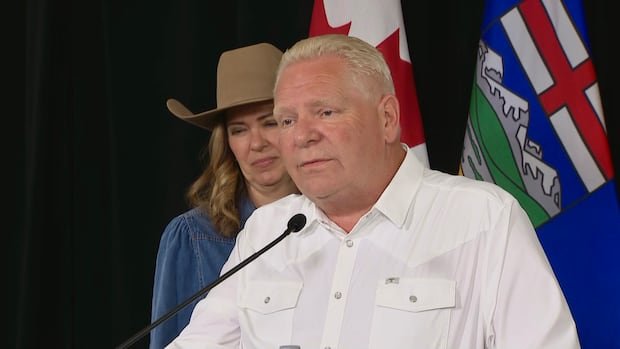

Alberta and Ontario’s premiers have introduced a plan for a 3,300 km pipeline to convey oil from Western Canada to refineries in southern Ontario. The proposed pipeline is projected to transport about 500,000 barrels of oil per day initially, with potential expansion capabilities up to 800,000 barrels per day. Premier Danielle Smith of Alberta and Premier Doug Ford of Ontario revealed the plan in Calgary on Monday, presenting a prospective route starting at Hardisty, Alberta, passing near Regina and Winnipeg, and terminating at Sarnia, Ontario.
Although still in the early stages, the project lacks a defined cost estimation or timeline. Last autumn, the Ontario government initiated a feasibility study to assess the project’s viability and associated costs, while also commencing talks with Indigenous communities. This pipeline initiative follows a previous agreement among Ontario, Alberta, and Saskatchewan to explore an energy corridor.
During the announcement, Ford emphasized the urgency in safeguarding Canadian jobs and families, stressing the need for swift action to advance the Northern Shield Energy Corridor, building upon the previous year’s agreement.
The envisioned corridor aims to facilitate the transportation of oil, natural gas, and other energy products from Alberta and Saskatchewan to refineries and ports in southern Ontario. According to Ford’s office, the feasibility study has incurred costs of $11 million thus far, with the final expenses to be determined upon completion, expected by year-end.
However, the Manitoba government has declined to participate in the initiative due to the absence of direct involvement of Indigenous groups from the project’s inception. Premier Wab Kinew of Manitoba expressed a commitment to pursuing extensive projects that prioritize Indigenous partnerships from the outset rather than post-consultation.
On Monday, Ford expressed optimism for a resolution with Kinew, acknowledging the need for further consultations in Manitoba. He proposed the possibility of the Ontario government taking ownership of the pipeline and assuming construction costs if necessary, exploring various investment options.
Furthermore, Ford disclosed a recent meeting with Dawn Farrell, overseeing the federal Major Projects Office, to discuss the pipeline project. The proposed pipeline not only aims to meet domestic demands but also opens avenues for potential oil exports to Europe, as mentioned by Smith.
Ontario currently depends on Western Canada for a significant portion of its oil supply, primarily through U.S. pipelines, a dependency that the ‘Northern Shield’ pipeline aims to alleviate. Notably, only approximately 15% of Ontario’s crude oil consumption between 2020 and 2023 was sourced from outside Canada, as per the Canada Energy Regulator.
Ontario houses three refineries in Sarnia and one in Nanticoke, underscoring the importance of securing a domestic oil supply chain. This recent announcement follows Smith’s advancement with a separate pipeline project to the West Coast last week.
Alberta has also put forth a proposal for an oil pipeline to the southwest coast of British Columbia in collaboration with federally-owned Trans Mountain Corp. and Calgary-based Pembina Pipeline Corp. as the private proponent.