

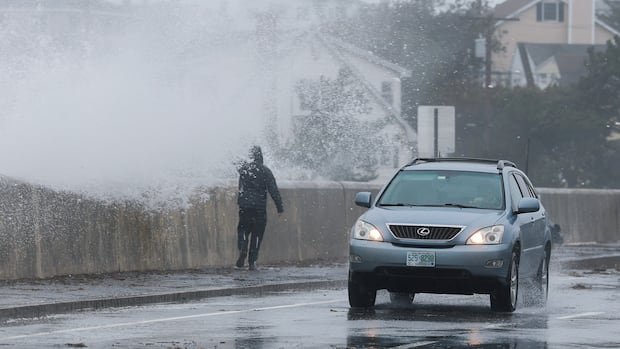

Residents living along the coast in the northeastern United States navigated through floodwaters for a second consecutive day as a potent nor’easter battered the shoreline on Sunday, causing power outages for tens of thousands of households.
High tides inundated low-lying neighborhoods in New Jersey while strong winds in New York’s Long Island uprooted trees, damaging residences and bringing down utility poles.
In Sea Bright, New Jersey, each high tide cycle brought renewed flooding, with Caroline Virenius remarking on the repetitive wetness, stating, “It’s not like a one-time occurrence.” Her garage was filled with about a foot of water.
The slow-moving storm, which resulted in the death of a New York City housing authority worker due to a fallen tree on Saturday, was forecasted to persist through Sunday with heavy rainfall, strong winds, and hazardous surf extending up to New England.
Unprecedented rainfall amounts, exceeding 10 centimeters since Friday in certain areas of New Jersey, coupled with a rising ocean, led to flood levels not witnessed for nearly a decade in regions accustomed to dealing with high water, according to residents.
Impacts on Flights and Utilities
The nor’easter evoked memories of Superstorm Sandy, which caused over $60 billion in damages across the eastern U.S. in 2012. While the current storm’s impact is not as severe, it could be the initial of numerous storms along the East Coast this autumn due to an El Niño climate pattern disrupting this year’s weather.
Concerns about coastal erosion were raised as images of waves crashing into sea walls and beaches circulated.
Over 100,000 customers experienced power outages across the Northeast and mid-Atlantic regions at various points on Sunday, as per PowerOutage.us. The most extensive outages were noted in coastal counties from New Jersey to Connecticut.
Numerous flights were either canceled or delayed up and down the coast. Boston Logan International Airport saw more than 250 canceled flights by late Sunday morning due to wind gusts reaching 64 km/h, reported the Massachusetts Port Authority.
Concerns Over Flooding
The heaviest remaining rainfall was anticipated on Sunday from northern New Jersey to southern New England.
Although the storm was gradually weakening, tidal flooding was predicted to persist through Sunday night’s high-tide cycles, stated Bob Oravec, a lead forecaster with the National Weather Service in College Park, Maryland.