

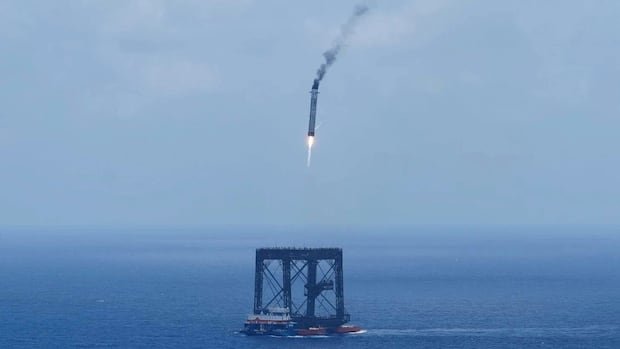

China achieved a significant milestone in its space program by successfully landing the first stage of a rocket following a launch on Friday, as reported by state media. The Long March-10B rocket’s first stage separated from the second stage after liftoff and returned to a platform in the sea, according to the official Xinhua News Agency.
This marked the first instance of China recovering a rocket’s first stage, a practice that SpaceX has been implementing for years to reduce launch costs through booster reuse. SpaceX, led by Elon Musk, and Blue Origin, founded by Jeff Bezos, have been at the forefront of rocket recovery efforts since 2015. SpaceX has achieved over 600 successful landings of its first-stage Falcon boosters, utilizing ocean barges and landing zones near launch pads. Recently, SpaceX set a new record with its 36th booster launch this week.
For SpaceX’s larger Starships undergoing test flights in Texas and soon expanding to Florida, the company is developing mechanisms to capture returning rockets with giant mechanical arms at the launch pad.
Blue Origin initially landed its New Shepard boosters in Texas after short flights to the edge of space, progressing to recover its larger New Glenn boosters on a floating platform off the Florida coast. With China entering the realm of rocket recycling, Japan is poised to conduct a launch and landing attempt in the near future.
The Long March rocket’s launch took place from Hainan Island, a popular beach destination off China’s southern coast. Xinhua mentioned that the rocket’s reusable configuration can carry payloads of up to 16,000 kilograms into low Earth orbit (LEO).
Comparatively, SpaceX’s Falcon 9 can handle a maximum payload of 22,800 kilograms, with Falcon rockets serving missions to the International Space Station. The Falcon Heavy variant can transport up to 63,800 kilograms to LEO. On the other hand, Blue Origin’s New Glenn is capable of launching payloads of up to 45,000 kilograms.
In a related development, Rocket Lab USA, a smaller launch company, successfully retrieved its first stage rocket in 2022 using a helicopter before depositing it in the ocean.