

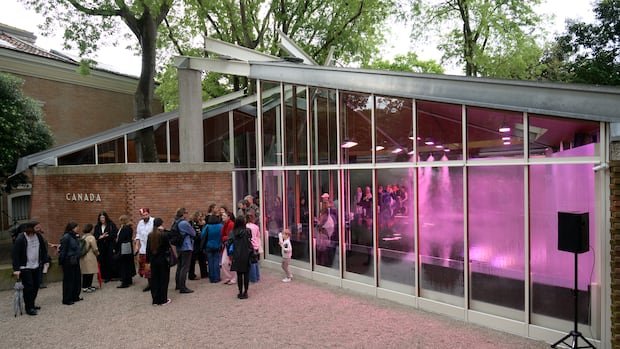

The Canadian pavilion at this year’s Venice Biennale offers a unique experience resembling a dynamic climate system rather than a traditional national representation.
The internal environment is meticulously adjusted to simulate the tropical heat of the Amazon, complete with warm mist diffused through small tubes. Notably, a significant portion of the pavilion has been transformed into an elevated pond featuring lily pads floating in dark, murky water.
Montreal artist Abbas Akhavan’s installation, “Entre chien et loup,” reimagines the pavilion as a grand Wardian case, akin to the glass containers utilized in the 19th century for plant transportation globally.
Central to the exhibit are Victoria water lilies, with seeds sourced from the Royal Botanic Gardens, Kew, in London, and nurtured at the esteemed Orto Botanico di Padova in northern Italy before being relocated to the pavilion for growth.
Akhavan sees the lily plant as a symbol of diverse histories, originating from an era of imperial exploration and classification of exotic treasures. However, the plant’s lineage predates these imperial endeavors by millions of years.
The installation delves into the narrative of how nature has been manipulated, renamed, and exhibited by dominant powers, shedding light on the unequal access to and preservation of the natural world. Amid global conflicts and environmental concerns, the Canadian pavilion prompts reflection on who holds the privilege of coexisting with nature and who is excluded.
The Venice Biennale, a prestigious art event, showcases artists every two years in national pavilions across various sites. Akhavan’s piece emphasizes the ancient nature of the lilies, which are expected to flourish during the Biennale, creating a living spectacle within the pavilion.
Lucy Smyth, collaborating artist and Kew affiliate, identifies the plant as Victoria boliviana, an ancient species now facing climate risks. The plant’s unique life cycle, culminating in a brief blooming period attracting beetles, underscores its essence as a record of movement and ownership.
Akhavan’s work symbolizes the journey of the water lily from South America to European cultivation and eventual display at an international art exhibition, exploring themes of scientific classification and control.
The installation’s title, “Entre chien et loup,” alludes to twilight, representing uncertainty between protector and predator amidst shifting power dynamics. Commissioned by the National Gallery of Canada and curated by Kim Nguyen, the work challenges traditional conservation narratives and imperial legacies.
In a crowded Venice Biennale, where quick judgments prevail, Akhavan’s ability to transform architectural elements into captivating art speaks to the enduring impact of his work. While the installation is meticulously researched and thought-provoking, its subtle nature may require a deeper engagement from viewers accustomed to rapid assessments at such events.