

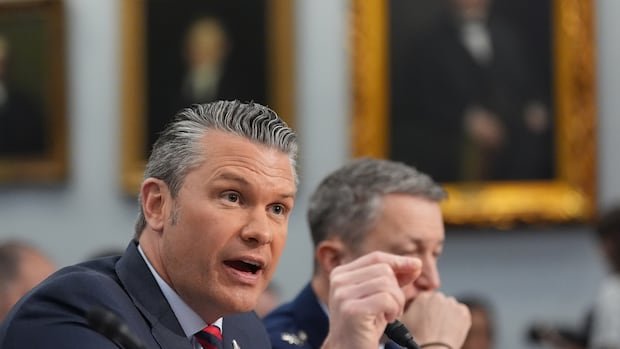

U.S. Secretary of War Pete Hegseth responded strongly to lawmakers last week who suggested a shortage of weapons in the country. During a hearing on May 12 with the House Appropriations Subcommittee on Defense, Hegseth dismissed the concerns about munitions scarcity as exaggerated and unhelpful. He affirmed that the country possesses an ample supply of munitions required for current operations.
While acknowledging Hegseth’s stance on the availability of munitions for Operation Epic Fury, the ongoing conflict with Iran, analysts express worry about potential future conflicts. Retired army major general John Ferrari, currently a senior fellow at the American Enterprise Institute, highlighted concerns about depleting stocks of certain high-cost weapons crucial for the type of warfare the U.S. typically engages in.
The Department of War, under Hegseth’s leadership, has initiated efforts to triple munitions production, aiming to address the looming shortages. A recent analysis by the Center for Strategic and International Studies identified key munitions critical for long-range ground attacks, air defense, and missile defense, affirming the current adequacy for Operation Epic Fury but cautioning about future risks.
The report emphasized the need to replenish depleted stockpiles to mitigate near-term risks and ensure sustained inventory levels over the years. The diminished munitions supply poses challenges not only for the U.S. but also impacts support to allies like Ukraine. Observers suggest a potential vulnerability due to reduced stockpiles, prompting concerns about national security in various geopolitical scenarios.
Democratic Sen. Mark Kelly’s remarks on the munitions shortage further fueled the debate, raising alarms about the depth of the issue and the time required for recovery. Hegseth’s response included launching an investigation into Kelly’s comments to assess if classified information was disclosed during the interview.
Michael Allan, an international relations professor at Boise State University, expressed concerns over reports indicating dwindling munitions amidst substantial military spending by the U.S. Observers noted that while the U.S. boasts significant short and medium-range missile inventories, the shortage in long-range munitions poses increased risk during operations.
The urgency to address munitions shortages stems from the necessity to deter adversaries like China and North Korea. The potential strategic implications of diminished stockpiles underscore the importance of maintaining adequate munitions levels for national defense and global stability.
Despite the focus on munitions inventories, experts like Michael O’Hanlon from the Brookings Institution emphasize that uncertainties such as the initiation of hostilities, communication systems’ resilience, nuclear escalations, and economic factors hold more significant strategic weight than the absolute quantity of weapons available. O’Hanlon argues that any adversary perceiving a window of opportunity based on depleted U.S. munitions may be taking significant and unwise risks.
Ultimately, the discussions around munitions shortages underscore the complex interplay between military preparedness, strategic calculations, and global security dynamics, necessitating a nuanced approach to addressing national defense imperatives.