

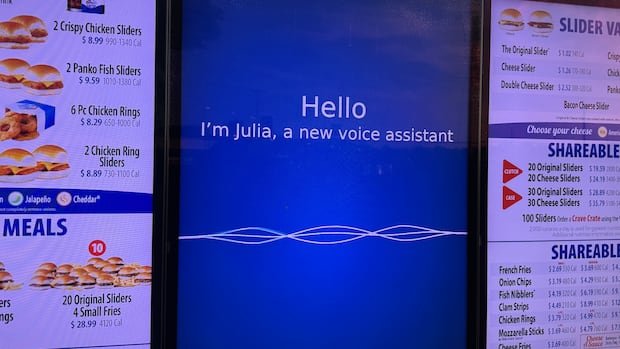

A bustling drive-thru in suburban Detroit appears ordinary until you approach close enough to discern the ordering voice—it’s not human, but artificial intelligence (AI). Fast-food chains across the U.S. are increasingly adopting AI for drive-thru operations, with Canada potentially following suit. Companies tout AI technology as more accurate than human counterparts, although concerns linger among labor advocates about potential job displacements.
The emergence of AI drive-thrus dates back to 2021, with initial pilot projects facing challenges as some customers deliberately tested the AI by making unusual requests or encountering errors. Despite viral incidents prompting a return to human interactions, recent advancements in voice AI technology have spurred the rollout of chatbots at various U.S. fast-food outlets. McDonald’s and Taco Bell, for instance, are testing Google-powered and Nvidia-partnered AI drive-thru systems, respectively.
Presto and SoundHound, U.S.-based custom voice AI firms, anticipate the arrival of chatbots at Canadian drive-thrus in the coming months. However, several fast-food chains declined to confirm these plans to CBC News.
White Castle collaborated with SoundHound to introduce an AI chatbot named Julia, which interacts with customers, relays orders to staff for preparation, and seamlessly transitions to human intervention if needed. Denise Harley, a store manager at White Castle, praised Julia for streamlining order processing and enhancing efficiency, with newer employees acclimating to AI as a commonplace tool.
Customer feedback on AI drive-thrus outside White Castle in Detroit varied, with some praising the convenience and accuracy while others expressed doubts about job implications. Despite ongoing technological refinements utilizing generative AI for continuous learning, concerns persist about workforce impacts. White Castle’s chief marketing officer emphasized the AI’s high order accuracy rates exceeding 90%.
With Julia operational at around 40 locations, White Castle credits the chatbot for reducing drive-thru wait times and optimizing employee tasks. The company maintains that AI implementation aims to enhance productivity rather than reduce employment.
Amidst labor challenges like high turnover rates and escalating costs, the fast-food industry sees AI as a strategic solution. SoundHound’s custom voice AI, Julia, is positioned to boost revenue through enhanced service quality and upselling opportunities. Industry projections indicate a growing reliance on AI tools, with voice AI innovations anticipated to revolutionize drive-thru operations.
Presto’s CEO envisions widespread adoption of voice-enabled drive-thrus in the near future, reflecting a broader industry shift towards AI integration. As automation reshapes job landscapes, concerns are raised about job losses, particularly impacting entry-level positions like cashiers. Labor advocates stress the importance of inclusive dialogues involving governments, workers, and unions to shape responsible AI implementation in workplaces.