

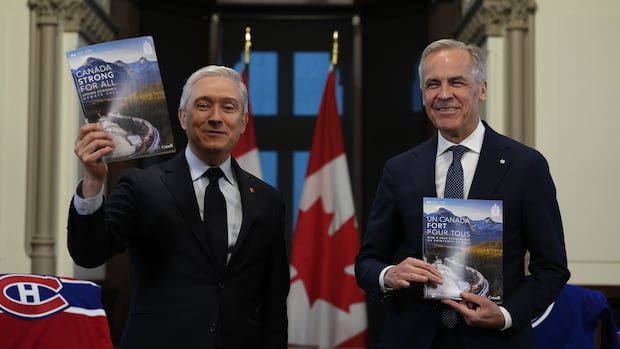

Finance Minister François-Philippe Champagne presented the spring economic update, revealing that the Liberal government is in a strong financial position due to a robust economy and rising oil prices. The update emphasizes the need for billions in new spending to train a significant number of skilled workers. However, it also highlights potential risks from global factors like trade tensions and geopolitical uncertainties.
Key points from the spring economic update include allocating $37.5 billion for new measures over six years, reducing last year’s deficit to $67 billion, proposing a program to train up to 100,000 skilled workers by 2030-31, investing $755 million in sports access and support for athletes, cutting CPP premiums in January 2027, and suggesting measures to address various issues such as air passenger complaints and disability tax credit applications.
Sahir Khan, from the University of Ottawa’s Institute of Fiscal Studies and Democracy, noted the positive impact of surging oil prices on the government’s finances, allowing for increased spending. The update projects a declining deficit over the years, with plans to balance the operating budget by 2028-2029.
The update also introduces a plan to bridge the shortage of skilled trades workers in Canada, with a $6 billion commitment to recruit and train 80,000 to 100,000 new workers by 2030-31. Additionally, it includes details on the establishment of a sovereign wealth fund and changes to CPP contributions to benefit Canadian workers and employers.
While the opposition expresses concerns over the deficit and affordability, the government aims to address citizens’ needs through strategic investments and policy changes. The update focuses on enhancing economic independence, supporting skilled trades, and streamlining processes to benefit Canadians across various sectors.