

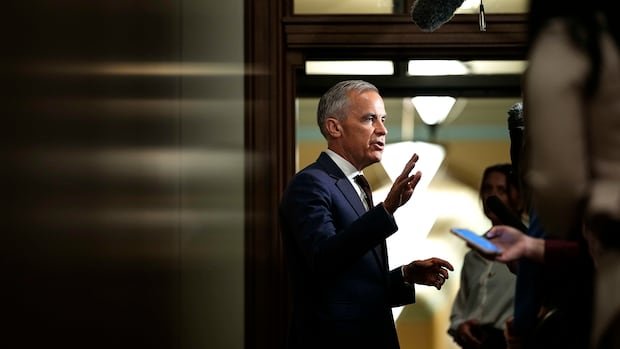

Prime Minister Mark Carney emphasized the ongoing transformation of Canada’s economy by his administration in response to the U.S. trade conflict. He attributed the recent technical recession to the economy’s adjustment phase. Carney highlighted the government’s efforts to bolster the Canadian economy through significant investments, operational changes, and new trade agreements.
According to Statistics Canada, the real GDP dipped by 0.1% in the first quarter of 2026 after a more substantial decline in the preceding quarter. This back-to-back contraction qualifies as a technical recession, although some economists and the Bank of Canada advised against overreacting to this data.
Carney mentioned measures taken to combat economic challenges, such as curbing immigration to stabilize population growth and moderating government spending growth rates. Notably, government spending and investment unexpectedly declined in the first quarter, impacting economic performance.
Despite the economic downturn, Carney highlighted positive trends in machinery and equipment investments, intellectual property, and research and development. Household incomes have been on an upward trajectory, outpacing inflation, yet there is room for further improvement.
BMO’s chief economist, Douglas Porter, pointed out the decline in government spending and investment as key factors in the weak economic performance. He highlighted the drop in exports and business investment due to trade uncertainty as additional challenges faced by the economy.
While acknowledging the technical recession, Porter noted resilient consumer spending in the first quarter. Conversely, Bank of Canada’s senior deputy governor, Carolyn Rogers, suggested a potential rebound in April, cautioning against solely relying on GDP contractions to assess the economy.
Scotiabank’s chief economist, Derek Holt, rejected the recession label, citing unusual factors like surging gold imports and weather disruptions affecting the GDP. He emphasized consumer strength and early signs of economic recovery in the subsequent quarter.
Conservative Leader Pierre Poilievre criticized the government’s handling of the recession, contrasting Canada’s economic situation with that of other G7 countries. He accused the Prime Minister of causing the recession and called for a reversal of current economic policies. Poilievre’s party sought an emergency debate and introduced a motion in Parliament to address the economic challenges.
The ongoing economic debates reflect differing perspectives on Canada’s economic performance amidst the technical recession.