

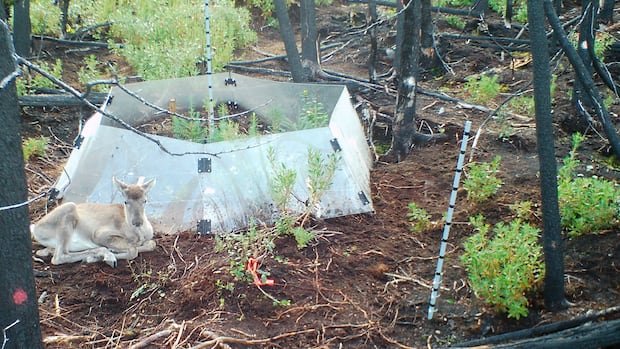

Lucas Brehaut anticipated keen interest in his study, but found that the wildlife in Newfoundland’s wilderness was not being gentle with his equipment. As a wildfire research scientist with the Canadian Forest Service, Brehaut is investigating the regrowth of forests in Atlantic Canada post wildfires, which are becoming more prevalent despite the region’s cooler and wetter climate compared to the rest of the country.
Following a forest blaze near Grand Falls-Windsor, N.L. in 2022, Brehaut embarked on understanding forest regrowth in a warming planet due to climate change. To conduct his study, he and his team had to transport 19 open-top chambers (OTCs) through the forest to place them around seedlings they had planted. These OTCs act as miniature greenhouses, elevating temperatures by one to three degrees to simulate planetary warming. The research project is currently in its third year out of a five-year duration.
Encountering challenges like traversing up to a kilometer in rough terrain and facing the harsh Newfoundland weather, Brehaut was surprised in September 2023 when he discovered unexpected issues during a routine check-in. Various animals, including caribou, moose, black bears, wolves, rabbits, and owls, had tampered with the greenhouses, with some even absconding with the temperature sensors.
Out of the 19 sites, 11 had experienced damage at some point. The animals not only destroyed the greenhouses but also took off with the temperature sensors, causing delays in the research process. Brehaut humorously referred to one site as the “Problem Child” due to its repeated damage incidents.
Despite the setbacks, Brehaut remained understanding and hoped the animals were enjoying themselves, acknowledging that they were simply acting within their natural habitat. Kaitlyn Gaynor, an assistant professor at the University of British Columbia, explained that animals are naturally curious about new objects in their environment, driven by the potential for food or threats, and our human scent can attract them to research equipment.
Animal interference in research is a global issue, as Gaynor experienced firsthand in Mozambique, where baboons, hyenas, and elephants were notorious for disrupting research activities. Gaynor emphasized that animals, not humans, were primarily responsible for equipment damage or loss.
However, Brehaut also faced challenges from human interference, with snowmobiles accidentally running over his research sites during snowy Newfoundland winters. Despite these obstacles, Brehaut maintains a positive outlook, recognizing the importance of coexisting with wildlife in their natural habitats.