

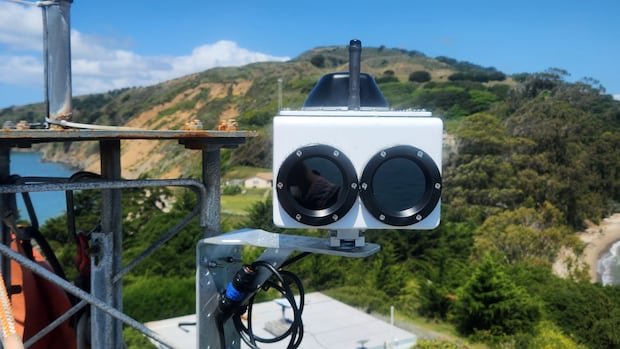

Marine experts in British Columbia are exploring a novel strategy for monitoring whale sightings, inspired by a successful initiative in California. A collaborative effort between scientists, ferry operators, and the public in San Francisco Bay has introduced innovative WhaleSpotter cameras, housed in white boxes the size of microwaves, equipped with thermal imaging technology to track whale movements around the clock. These sightings are documented in a public app alongside human-reported ones, enhancing whale protection efforts by increasing surveillance coverage.
Daniel Zitterbart, the chief scientist at WhaleSpotter, emphasized the importance of having more eyes on the water to safeguard whales. While similar cameras are deployed on Angel Island and San Francisco Bay Ferry vessels, British Columbia has land-based WhaleSpotter cameras only, limiting their whale detection range to approximately two nautical miles.
Monitoring marine mammals is crucial for understanding their migration routes and avoiding vessel collisions, a growing concern in British Columbia. Recent incidents, including documented whale strikes such as the death of a humpback whale in Wright Sound and a humpback calf hit by a ferry, underscore the urgency of implementing preventive measures.
In San Francisco Bay, the WhaleSpotter cameras are integrated with the Whale Safe app, facilitating collaborative tracking of whale sightings by scientists, mariners, researchers, and the public. This community-driven approach aims to create a comprehensive resource for whale conservation.
While in British Columbia, only authorized commercial mariners have access to camera data through the Ocean Wise whale report alert system, limiting public awareness of nearby whales. Efforts to install detection devices on ferry routes, particularly in areas frequented by humpback whales, are underway following fatal whale strikes.
Stakeholders, including Douglas McCauley, director of the Benioff Ocean Science Laboratory, stress the need for enhanced collaboration to protect whales amid rising ship traffic and changing environmental conditions. The initiative in San Francisco Bay has already observed an increase in grey whale sightings due to altered feeding patterns, highlighting the importance of proactive conservation measures.
Conservation biologist Sean Brillant of the Canadian Wildlife Federation emphasized the global significance of mitigating vessel strikes on whales, emphasizing the necessity of cross-border partnerships and data sharing for effective conservation efforts.
The push for collective action and data-driven conservation initiatives underscores the shared responsibility of safeguarding marine life across regions and borders.