

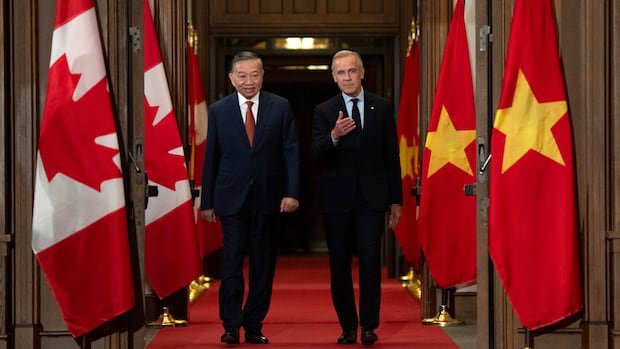

Vietnamese President Tô Lâm has elevated the relationship with Canada to a strategic partnership, following Prime Minister Mark Carney’s initiatives to enhance collaboration between middle powers in addressing pressures from the United States and China. Lâm emphasized the significance of trust, responsibility, and shared interests as strategic values in an uncertain global landscape during his address on Parliament Hill.
During his one-day state visit, Lâm engaged in various activities, including a tree-planting ceremony at Rideau Hall and a speech to parliamentarians and members of the diaspora. Being the first Vietnamese president to visit Canada, Lâm, who also leads the country’s communist party, holds a prominent position in Vietnam.
In a meeting at Carney’s West Block office, the prime minister praised Lâm for his leadership role as a middle power and highlighted the rapid progress in the bilateral relationship since a 2017 agreement covering investment, defense, and academia. Carney hinted at positive developments in direct travel between Canada and Vietnam, potentially involving direct commercial flights.
The strategic partnership signals enhanced cooperation on long-term objectives, according to Vina Nadjibulla, co-founder of the Centre for Strategic Statecraft. Despite ideological differences, both Vietnam and Canada aim to uphold the rules-based global order and promote economic diversification to avoid undue influence from any single power.
The renewed partnership will focus on collaboration in energy, agriculture, defense cooperation, and people-to-people connections, as mentioned by Foreign Affairs Minister Anita Anand. Lâm emphasized the importance of engaging in regular high-level discussions to address mutual interests promptly and efficiently.
Canada views Vietnam as a significant trading partner in Southeast Asia, with bilateral merchandise trade exceeding $20 billion last year. The two countries engage in trade of various goods, with Canada exporting food, metals, and fertilizers, while Vietnam exports electronics, clothing, furniture, and shoes.
Vietnam’s efforts to reduce dependence on the United States align with Canada’s objectives to diversify trade relationships. Both countries aim to lessen reliance on the U.S. market and explore new trade avenues. Vietnam is actively involved in combating forced labor in global supply chains, including those potentially linked to Uyghur slave labor in China.
As this year’s chair of the CPTPP, Vietnam plays a pivotal role in promoting rules-based trade among member countries. The bloc, which includes Canada, Chile, Japan, and Australia, emphasizes fair commerce practices and labor rights amid challenges such as trade restrictions and tariffs imposed by major economies.
The visit by President Tô Lâm underscores the growing international engagement with Canada, driven by Prime Minister Carney’s efforts to expand trade and diplomatic ties. Recent high-level visits from leaders of various countries reflect Canada’s emerging role as a middle power on the global stage.