

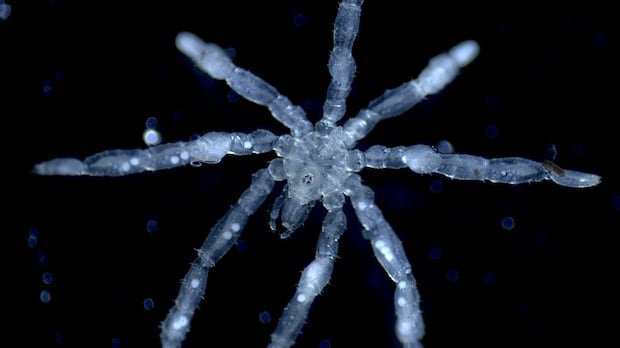

In the depths of the ocean, a peculiar creature with hairy legs and red eyes, known as a parasitic sea spider, may seem like something out of a nightmare. Surprisingly, these eerie beings are not just figments of imagination but actual inhabitants of planet Earth. Recently, researchers unveiled the existence of two new species of sea spiders thriving in the Salish Sea region of southern British Columbia.
Cormac Toller-Scott from the University of British Columbia spearheaded this discovery during his pursuit of a master’s degree in zoology. Shedding light on the rarity of research in marine invertebrates, Toller-Scott emphasized the significance of exploring sea spiders, which are distinct from their terrestrial counterparts due to their ancient evolution within the oceanic realm.
Prior to this study, only 20 sea spider species had been identified in the Salish Sea and Vancouver Island vicinity. Between September 2023 and August 2024, Toller-Scott and his research team ventured into the waters, conducting dives up to 18 meters deep across various marine habitats spanning Quadra Island, Vancouver, Bamfield, and Victoria.
Their meticulous investigations involved collecting diverse sea spider species, scrutinizing intricate body details, and comparing these findings with global sea spider characteristics. By integrating genetic analysis, the team unveiled two previously unknown species dwelling on a hydroid, a stationary organism akin to a grounded jellyfish.
One of the newfound species, named Callipallene pilosuspedes, derives its title from Latin, signifying “hairy feet,” alluding to the fine spines covering its lower limbs. The second species, Tanystylum kiixin, honors an Indigenous village near the collection site.
This revelation echoes a prior discovery by biologist Shana Goffredi and her team at UBC, who stumbled upon three sea spider species near methane seeps and hydrothermal vents, showcasing a unique ability to cultivate bacteria that convert methane into essential nutrients.
Despite the crucial role of taxonomic research projects like the sea spider study in advancing scientific knowledge, funding for such endeavors remains limited. Toller-Scott stressed the importance of taxonomy in comprehending ecosystems, hinting at numerous undiscovered species awaiting revelation along the diverse coastline of western Canada.