

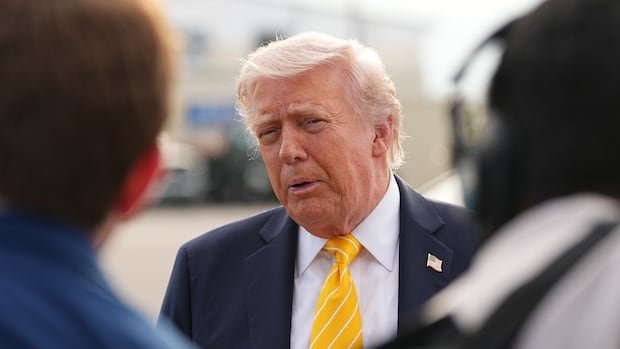

U.S. President Donald Trump mentioned on Saturday that he is examining a new Iranian proposal aimed at resolving the conflict, but he cast doubt on the likelihood of reaching an agreement.
“I will provide updates later,” Trump stated before boarding Air Force One, mentioning that he is awaiting the precise wording from the Iranian side.
Following his remarks to the press, Trump took to social media to express his skepticism about the new proposal, indicating that he doubts its acceptability due to what he perceives as insufficient accountability for Iran’s actions over nearly five decades.
Reports from two semi-official Iranian news sources, Tasnim and Fars, which are believed to have ties to Iran’s Revolutionary Guard, indicated that Iran has conveyed a 14-point counterproposal through Pakistan in response to a nine-point U.S. proposal. Notably, Iran’s state media outlets have not covered this development. Pakistan has previously served as a venue for negotiations between Iran and the United States.
Despite Trump rejecting a previous Iranian proposal earlier in the week, conversations have persisted, and the ceasefire that has been in place for three weeks appears to be holding.
In another development, the United States issued a warning to shipping companies on Friday, cautioning them that they could face sanctions if they make payments to Iran for passage through the strategically important Strait of Hormuz.
The notice, released by the U.S. Office of Foreign Assets Control (OFAC), further escalates tensions between the U.S. and Iran over control of the strait, a vital route through which approximately one-fifth of the world’s oil and gas trade typically flows.
Iran disrupted normal traffic through the strait by attacking and threatening vessels after a conflict began on Feb. 28, following actions by the U.S. and Israel. Subsequently, Iran began offering select ships safe passage by redirecting them through alternative routes closer to its shores, sometimes charging fees for the service.
Nobel laureate Narges Mohammadi, who is imprisoned, was transferred to a hospital in Zanjan, northwestern Iran, from prison on Friday. Her foundation described her condition as critical, with fluctuating blood pressure and severe nausea.
Medical professionals in Zanjan have requested her medical records before administering treatment, recommending that she be moved to Tehran for care by her personal doctors. However, her husband, Taghi Rahmani, based in Paris, mentioned that the Intelligence Ministry opposes transferring Narges to a hospital in Tehran for an angiography, a procedure to visualize blood vessels. Rahmani emphasized that until the angiography is conducted, her underlying illness cannot be definitively determined.
The article also reports Iran’s execution of two individuals, Yaghoub Karimpour and Nasser Bekrzadeh, convicted of spying for Israel. Mizanonline, the news outlet of Iran’s judiciary, disclosed that the men were hanged after their death sentences were upheld by the Supreme Court. Karimpour was accused of sharing sensitive information with an officer from Israel’s Mossad intelligence agency, while Bekrzadeh was alleged to have provided details on government and religious figures, as well as information about Natanz, a city in central Iran housing a nuclear facility that was targeted in airstrikes by Israel and the U.S. last year.
Iran has executed more than a dozen individuals in recent weeks on charges of espionage and terrorism.
Additionally, negotiations between the U.S. and Iran have persisted through phone conversations, following Trump’s cancellation of envoys’ travel to Pakistan. Trump has floated a new plan to reopen the Strait of Hormuz, crucial for Gulf allies’ oil and gas exports. Iranian Foreign Minister Abbas Araghchi has briefed regional counterparts and engaged with European Union officials on Iran’s peace initiatives. Meanwhile, aviation operations in the United Arab Emirates have returned to normalcy after precautionary measures implemented at the onset of the conflict were lifted.
The ongoing standoff between the U.S. and Iran has raised concerns about its impact on the global economy, with rising prices and shortages affecting industries reliant on oil products.