

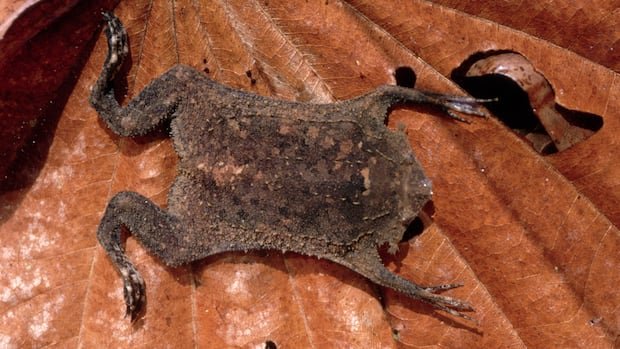

In a fascinating discovery, researchers in California have unveiled a unique ability of the Surinam toad – it can effectively “see” with its fingertips. This toad, known for its peculiar traits like giving birth through holes in its back, possesses star-shaped fingertip lobes that aid in prey detection.
Despite its small eyes and limited vision, the Surinam toad excels as a hunter in the murky waters it inhabits. Scientists have long been intrigued by how this toad swiftly captures prey with its powerful suction feeding technique. The recent study by Duncan Leitch and his team at the University of California, Los Angeles, sheds light on this mystery.
Through meticulous research, it was revealed that the toad, often referred to as a star-fingered toad, utilizes its specialized fingertips to detect subtle water movements caused by nearby prey. These star-shaped lobes act as highly sensitive touch organs, akin to the human eye’s fovea, enabling the toad to identify the size and proximity of potential meals.
The findings indicate that the Surinam toad can draw prey into its mouth without direct contact, showcasing its remarkable tactile abilities. Each toad’s fingertips house 128 intricate lobes, densely packed with touch-sensitive nerves and papillae that enhance sensitivity, comparable to human fingertips.
Moreover, the study highlights the significant brain real estate dedicated to processing sensory information from these fingertips, underscoring the toad’s remarkable adaptation for effective hunting. This unique strategy, analogous to complex mammal brains, suggests a convergent evolution between frogs and mammals over millions of years.
Lea Randall from the Wilder Institute in Calgary emphasizes the importance of this discovery, noting how it provides insights into vertebrate evolution and brain functionality. Understanding how these creatures have evolved to optimize sensory capabilities offers valuable insights into the intricacies of brain development across different species.