

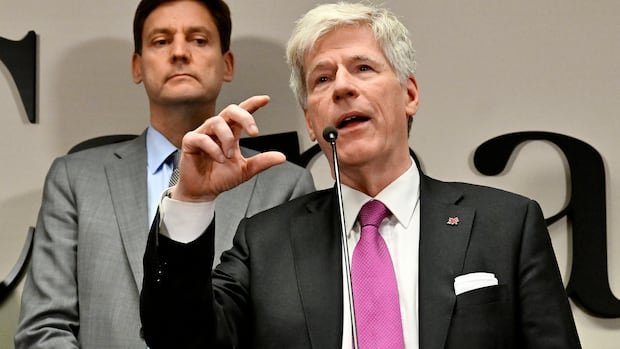

Canada’s forestry industry is facing significant challenges that extend beyond previous tariffs under the Trump administration, according to the federal minister overseeing natural resources. Tim Hodgson emphasized this point while announcing nearly $130 million in funding for 56 forestry projects nationwide. Hodgson, currently in Langford, B.C., meeting with provincial and territorial forest ministers, also highlighted internal issues such as unstable fiber access and insufficient domestic demand that are jeopardizing the sector.
Acknowledging the struggles, Hodgson mentioned an additional $2 billion in federal support since August 2025 to help the industry combat American tariffs. However, he noted a pivotal moment for forestry, with over a dozen sawmills shutting down, resulting in 2,000 job losses, and 40 curtailments leading to 1,000 temporary job cuts.
Describing the industry’s state as a crisis demanding transformation, Hodgson stressed the importance of evolving into a modern, prosperous sector that can shape Canada’s future and ensure sustainable growth. The industry faces existential risks due to both external pressures like U.S. softwood lumber duties and internal hurdles, including inadequate domestic demand and regulatory constraints.
Forest Products Association of Canada President Derek Nighbor endorsed the report as a comprehensive guide that requires immediate implementation to address core industry challenges. The $130 million funding allocation, with approximately $67 million directed to British Columbia, aims to support projects like the Forest Enhancement Society of B.C.’s initiative in Kamloops. This project, receiving $37 million, focuses on utilizing low-value and residual fiber for pulp, bioenergy, and pellets production, instead of discarding it.
B.C.’s Forest Minister, Ravi Parmar, welcomed the funding and report, emphasizing the necessity of structural changes to ensure stability and certainty in the industry. He highlighted the need to shift from a boom-and-bust cycle to a more sustainable sector. Parmar plans to introduce legislation addressing the barriers identified in the report, aiming to increase B.C.’s fiber supply significantly through new timber sales licenses and streamlined salvage processes.
The Canadian Council of Forest Ministers will deliberate on the task force recommendations, with the federal government set to publish an action plan laying the groundwork for a comprehensive forestry strategy. The proposed changes are expected to enhance the sector’s resilience and foster long-term growth.