

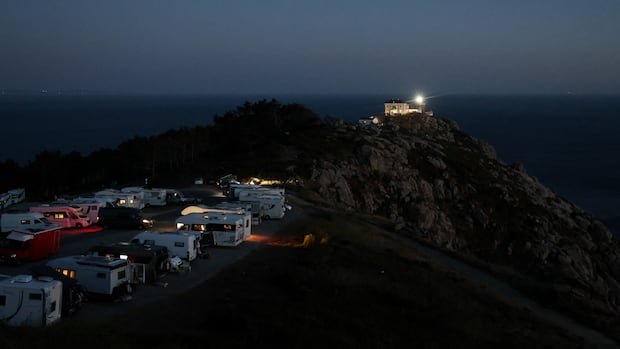

Hundreds of tourists have flocked to Spain to witness the solar eclipse happening this Wednesday. However, the event coincides with high temperatures and an increased wildfire risk, prompting concerns for authorities aiming to prevent long-term fire damage.
Virginia Barcones, the secretary general for civil protection and emergencies at Spain’s Interior Ministry, emphasized the need to restrict activities that could potentially ignite fires due to the challenging summer marked by major forest fires.
Spain is currently facing a severe wildfire season, with over 603,000 acres of land charred by approximately 400 fires this year. To prevent eclipse tourists from adding to these statistics, authorities are deploying 35,000 officers to monitor large outdoor gatherings for any potential fire risks.
Spain is positioned as one of the prime locations to observe the solar eclipse, with the path of totality spanning across northern Russia, eastern Greenland, western Iceland, northeastern Portugal, and a significant part of northern Spain, ending at the Balearic Islands.
Only individuals within the path of totality will witness the total coverage of the sun by the moon. While Canada will experience a partial eclipse, viewers are reminded to use proper eyewear for eye protection.
This eclipse marks the first time in 120 years that mainland Spain will witness a full solar eclipse, leading to a surge in travel interest. Special measures have been put in place to manage the anticipated crowd influx, with a notable spike in lodging searches reported in Valencia.
With expectations of more than 440,000 people and an estimated 1.5 million individuals traveling to viewing sites, 660 official observation sites have been designated by regional governments. Authorities caution against fire risks, advising against barbecues and venturing into dry areas.
The economic impact study by the Ministry of Economy, Trade, and Business forecasts that the eclipse will contribute over 347 million euros to Spain’s economy. Despite the dry conditions and wildfire concerns, eclipse enthusiasts remain undeterred, drawn by the rare spectacle of nature.
AEMET forecasts high temperatures on eclipse day, with the risk of wildfires exacerbated by extremely dry conditions across Spain. The presence of more people in rural areas poses a higher potential for human-caused wildfires.
Amidst the heat wave and fire risks, eclipse travelers continue to show enthusiasm. The eclipse’s unique experience, including temperature drops and the visibility of stars during the day, often prompts individuals to plan future eclipse-viewing trips.
This eclipse, the first in a series visible from Spain in the coming years, is expected to attract more astrotourism. The subsequent eclipses in 2027 and 2028 are anticipated to draw even greater interest, with the 2027 eclipse path crossing through southern Spain to other countries, offering unique viewing opportunities.