

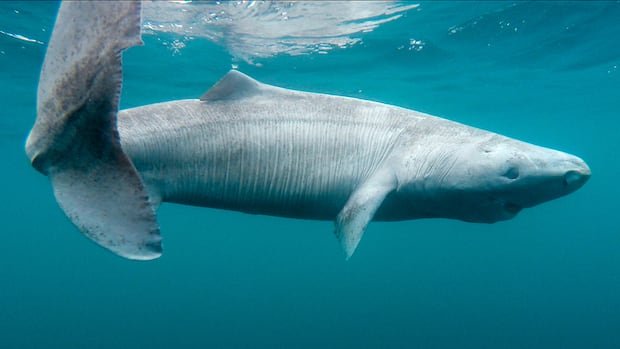


Upon hearing of a deceased Greenland shark stranded on the northwest coast of Ireland, zoologist Emma Murphy was taken aback.
These massive, ancient creatures are known for their elusive nature, typically inhabiting the remote depths of the Arctic and North Atlantic oceans.
“I was completely astonished,” expressed Murphy, a zoology curator at the National Museum of Ireland, in an interview with As It Happens host Nil Kӧksal. “Our excitement was beyond words.”
According to the museum, the presence of this species in Irish waters is exceptionally rare. This marks the first recorded instance of a Greenland shark being stranded on the coast of Ireland.
While Irish researchers examine the remains of the shark, a scientist suggests that the species may have a broader distribution than commonly believed.
Longest-lived vertebrate in the world
A passerby discovered the shark near the town of Sligo on April 11 and promptly informed the Irish Whale and Dolphin Group, a conservation organization with a hotline for reporting stranded marine mammals.
Initially mistaken for a deceased basking shark, a species frequently found off the Irish coast, the true identity was confirmed through photographs by scientists at the charity, who then alerted their counterparts at the National Museum of Ireland in Dublin.
“We were eager to reach the site as soon as possible,” Murphy stated.
As stated by the St. Lawrence Shark Observatory, the Greenland shark is among the world’s largest carnivorous shark species, trailing only the great white shark. Typically measuring between three to five meters in length, they can reach up to seven meters.
With a lifespan exceeding 270 years, the Greenland shark holds the title of the world’s longest-lived vertebrate. The oldest documented individual was approximated to be 400 years old.
Unexpected habitat range
Although the primary habitat of Greenland sharks is the cold waters of the Arctic and North Atlantic regions, including Quebec and Atlantic Canada, shark expert Dean Grubbs suggests that Ireland falls within the known range of the species.
Grubbs, the associate research director at Florida State University Coastal and Marine Laboratory, explained in an email to CBC that as a large, mobile predator, Greenland sharks can thrive in cold temperatures below 6 degrees Celsius, allowing them to move across various regions.
Given their preference for depths around 2,000 meters below the ocean’s surface, these sharks have been spotted in unexpected locations like Belize and the Gulf of Mexico.
“They are likely more widespread than current knowledge suggests due to limited exploration of deep-sea habitats,” Grubbs remarked.
‘Incredibly mesmerizing creatures’
Owing to their deep-sea habitat, Greenland sharks are rarely encountered by divers. The first underwater images of a live Greenland shark were captured in 1995 in the Arctic, with the first video recorded in the St. Lawrence Estuary in 2003.
When Murphy and her team had the chance to observe one up close, they were thrilled by the encounter.
“We had to navigate through rocky terrain, similar to a surf break, to reach the shoreline where the shark lay,” she described. “Our excitement was palpable, almost running towards it.”
The experience surpassed their expectations, with Murphy describing the shark as “a majestic and rare creature washed ashore,” emphasizing their beauty.
Fortunately, the shark showed no signs of decay. With the assistance of local volunteers and a crane, the team successfully retrieved the carcass for examination at a nearby Department of Agriculture facility