

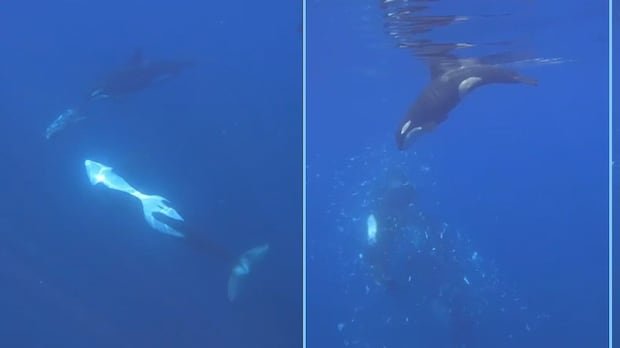

Orcas in the Gulf of California have been captured on video working together to shatter dead sunfish into pieces. The process involves one orca gripping the sunfish’s tail, known as a clavus, in its mouth and releasing it right before another orca collides with it at high speed, resulting in the sunfish exploding into fragments.
A recent study published in the journal Frontiers of Ethology by researchers from the U.S., Saudi Arabia, and Mexico sheds light on this behavior. The researchers suggest that this cooperative smashing may assist younger orcas in feeding more efficiently or could simply be a form of playful interaction, as orcas are known to play with their food.
The sunfish targeted in these incidents were sharp-tail sunfish, which can reach lengths of up to three meters and weigh two tonnes. Prior to the smashing, the orcas had already removed the sunfish’s internal organs.
While the adult orcas were responsible for breaking the sunfish, the younger orcas predominantly consumed the resulting pieces. The adults concentrated on the larger remaining chunk that had not fragmented.
The behavior was initially observed and filmed by scientist Kathryn Ayres from the ocean conservation group Beneath the Waves in July 2024. A similar event was captured on video in September 2025 by Héctor Franz, a digital creator involved in ecotourism in the same region. Co-author of the study, Erick Higuera, mentioned witnessing comparable behavior in the area back in 2021.
Due to unclear footage, the researchers cannot confirm if the same orcas were involved in the different incidents. The researchers proposed that the unique structure of the sunfish species’ clavus might explain why it breaks into pieces upon impact, as this feature is more pronounced compared to other sunfish species.
Orcas have previously exhibited the behavior of tearing prey into smaller portions to share with their offspring. Marine ecologist Robert Pitman from Oregon State University suggested that the smashing technique might help orcas access the meat without damaging their teeth on the fish’s scales.
While orcas have been known to playfully ram boats in regions like Spain and Portugal, the act of ramming prey to disintegrate it was unprecedented. Kathryn Ayres remarked, “They’re one of the most iconic marine predators in the world, yet they continue to surprise us.”