

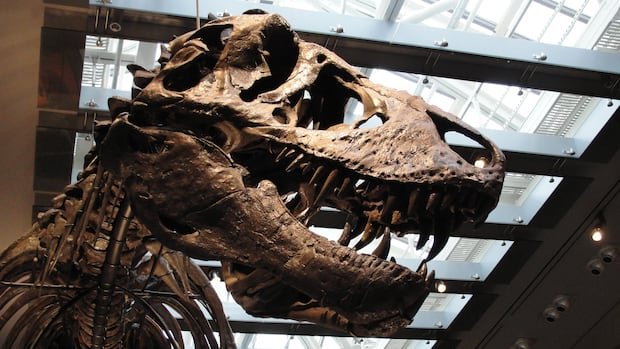

Scientists have been debating the warm-bloodedness of dinosaurs for a while. Now, a new study claims to have gauged the body temperature of two T. rex specimens using a chemical approach.
Aradhna Tripati, a geochemist and professor at the University of California, Los Angeles, admitted the challenges involved in this unique investigation. She co-wrote the study published in Science Advances and discussed the methodology with CBC’s Quirks & Quarks before an interview with host Bob McDonald.
Instead of conventional temperature-taking methods, researchers utilized a chemical technique that indicates temperature variations in hard tissues like tooth enamel and eggshells. These tissues contain a mineral known as bioapatite, where carbon atoms bind with oxygen. The presence of a heavier carbon isotope (carbon-13) bonding with a rarer oxygen isotope (oxygen-18) indicates lower temperatures due to enhanced stability in the bonds.
By comparing the isotope clumping in present-day animals with different body temperatures, scientists can extrapolate the body temperature of extinct creatures, including dinosaurs. A previous study by UCLA scientists a decade ago concluded that titanosaurs and oviraptors were warm-blooded based on eggshell analysis.
In the case of T. rex, which has thin tooth enamel, obtaining samples for analysis was tricky. Researchers fine-tuned their technique using teeth from the megalodon shark before obtaining samples from the young adult T. rex known as Thomas. By examining the tooth samples, they estimated T. rex’s body temperature to have ranged between 33.8°C and 38.8°C, akin to large mammals like elephants and flightless birds such as ostriches.
This discovery has implications for understanding the behavior and habitat range of T. rex. A warm-blooded T. rex, Tripati explains, could have roamed various climates, including Arctic regions, unlike cold-blooded reptiles.
Paleontologist Anthony Fiorillo, who identified a small tyrannosaur in Alaska, commended the study’s findings, suggesting it sheds light on how dinosaurs adapted to diverse environments. François Therrien, a curator at the Royal Tyrrell Museum, used similar techniques to analyze troodon eggshells, revealing they exhibited warm-blooded characteristics akin to birds.
While the study offers insights into T. rex’s active lifestyle, questions remain about its metabolic rate compared to modern warm-blooded creatures. Therrien speculates that sustaining such a metabolism might have posed challenges given the ecosystem’s constraints, warranting further debate.