

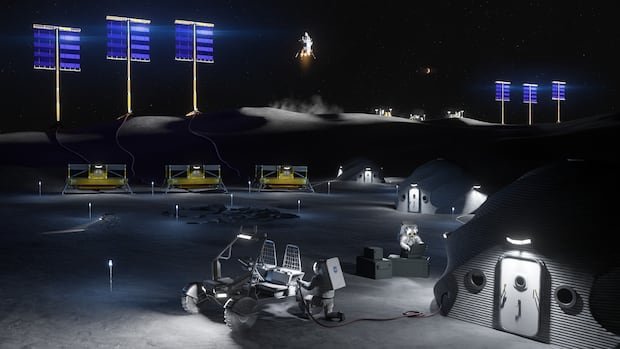

NASA revealed plans for a lunar base in a recent press conference, along with its commercial partners involved in the project. NASA administrator Jared Isaacman expressed optimism about the return to the moon, emphasizing the goal of establishing a permanent human presence there as part of the Artemis program.
These plans stem from the success of the recent Artemis II mission and a strategic shift within NASA, which included the addition of new Artemis missions and a temporary halt to the Lunar Gateway project. MDA Space from Canada was initially slated to contribute Canadarm3 to the Lunar Gateway.
The Moon Base initiative features different components such as Moon Base 1, which will include a lander by Blue Origin set to launch later this year. Moon Base 2 will incorporate lunar terrain vehicles (LTVs) from Astrolab and Lunar Outpost, both part of NASA’s Commercial Lunar Payload Services (CLPS) program. Moon Base 3 will integrate payloads from the European Space Agency and the Korea Astronomy and Space Science Institute.
Furthermore, the plans include lunar drones from NASA’s Jet Propulsion Laboratory, to be delivered by Firefly Aerospace, a commercial partner. The Moon Base project aims to collaborate with international and commercial partners to leverage their capabilities for the successful establishment of a lunar outpost.
The Moon Base is envisioned to cover hundreds of square miles, with a phased approach that includes multiple launches and landings to deliver cargo to the moon’s surface. The ultimate goal is to establish a permanent human presence on the moon, with Artemis IV being the next mission planned for 2028.
The announcement of the Moon Base initiative has sparked excitement among experts like Gordon Osinski, a professor at Western University, who believes that the upcoming moon-based missions could materialize sooner than expected. Osinski highlighted the importance of aiming high and staying ambitious in space exploration endeavors.
While Canada’s involvement in the Moon Base project is not explicitly mentioned, experts like Osinski suggest that Canada needs to align its efforts with NASA’s accelerated pace in space exploration. NASA officials have hinted at more developments in the pipeline, signaling a significant step towards establishing a sustained presence on the lunar surface.