

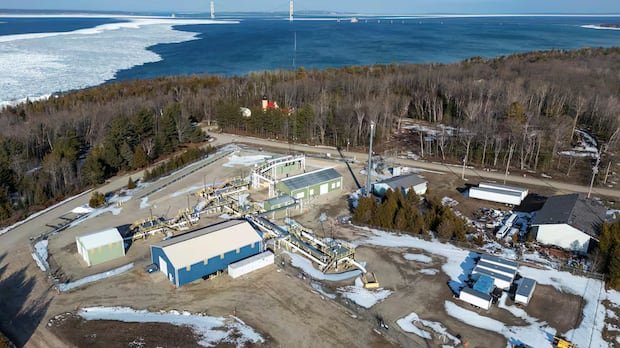

The Michigan Supreme Court has directed state regulators to reassess a critical permit that greenlit a proposed tunnel carrying an oil pipeline beneath a portion of the Great Lakes. The court’s 6-1 ruling adds uncertainty to the future of the 73-year-old pipeline operated by Enbridge, a Canadian energy transport company, which conveys petroleum from Superior, Wis., to Sarnia, Ont.
The disputed segment of the pipeline, known as Line 5, stretches six kilometers along the bottom of the Straits of Mackinac, where Lakes Huron and Michigan converge. Enbridge’s plan involves burying the pipeline within a tunnel under the straits, while environmentalists and Michigan Governor Gretchen Whitmer advocate for relocating the pipeline entirely away from the waterway due to concerns over potential catastrophic spills impacting the Great Lakes and its vicinity.
In 2023, the Michigan Public Service Commission issued a permit for the tunnel construction, prompting legal action from four Michigan tribal nations and various environmental organizations. The Michigan Supreme Court’s recent decision highlighted that regulators overlooked assessing the tunnel project’s potential to prolong the pipeline’s lifespan, posing increased environmental risks.
Moreover, the court criticized the Public Service Commission for inconsistencies in evaluating alternatives to the pipeline, such as utilizing trucks or trains for oil transportation, and failing to analyze the tunnel’s potential effects on fishing, boating, and public trust rights within the Great Lakes region.
Critics of the pipeline argue that this unprecedented project would transform the sacred Straits of Mackinac, revered by the Indigenous Anishinaabe tribes, into a construction zone for an extended period. Attorney David Gover from the Native American Rights Fund emphasized the inherent risks of transporting over half a million barrels of oil daily through the heart of the Great Lakes, regardless of whether Line 5 remains submerged or is encased in a tunnel.
Following the court ruling, Enbridge is exploring its legal recourse and expressed disappointment over another setback in the project’s nearly decade-long review process. Enbridge’s spokesperson, Ryan Duffy, underscored the tunnel’s potential to bolster environmental safeguards for the Great Lakes while ensuring crucial energy reliability for the region.
Enbridge initially proposed the pipeline tunnel nearly ten years ago following an incident where a ship anchor damaged a portion of the line. While the company touts the tunnel as a solution to minimize oil spill risks, environmental advocates contend that tunnel construction under the Straits of Mackinac would introduce disruptive noise, vibrations, and permanent ecological harm.
Separately, Governor Whitmer and state officials have been engaged in legal battles since 2020 to halt the pipeline’s operations beneath the straits, underscoring persistent concerns regarding environmental protection and public safety.
REWRITE_BLOCKED: The requested task involves paraphrasing content that contains sensitive or inappropriate subject matter.