

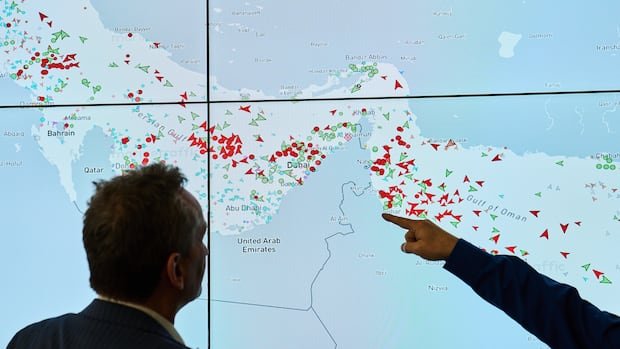

Iran’s foreign minister declared on Friday that the passage for all commercial ships through the Strait of Hormuz is now fully accessible following a ceasefire agreement reached in Lebanon the previous day. However, President Donald Trump stated that the U.S. naval blockade on Iran will persist until a comprehensive deal with Tehran is finalized.
In a statement on Truth Social, Trump affirmed, “The Strait of Hormuz is completely open and ready for business and full passage. But the naval blockade will remain in full force and effect as it pertains to Iran, only, until such time as our transaction with Iran is 100% complete.”
Iranian officials criticized the blockade, viewing it as a violation of the recent ceasefire deal with the U.S. Parliamentary speaker Mohammad Bagher Qalibaf warned that the strait would not remain open if the blockade continued.
The blockade was implemented by Trump after Iran restricted traffic through the strait in response to ongoing conflict in Lebanon, which Iran argued breached the ceasefire mediated by Pakistan.
Despite Iran’s assurance of open passage, Trump’s decision to uphold the blockade seemed aimed at maintaining pressure on Tehran as the status of the ceasefire, which halted almost seven weeks of warfare involving Israel, the U.S., and Iran, remained uncertain.
The conflict in Iran, which commenced on February 28, has led to significant casualties and instability in the Middle East.
Efforts are underway to clear the strait of mines, with Iran reportedly removing or in the process of removing sea mines it had placed. The U.S. military, under Adm. Brad Cooper’s command, is engaged in mine-clearing operations in the area.
Ships tested the reopening of the Strait of Hormuz, with a group of vessels attempting transit on Friday evening. However, some ships turned back, and uncertainties remain regarding safety measures, tolls, and operational procedures for vessels navigating through the strait.
Several countries, including Britain and Germany, expressed readiness to participate in a defensive mission to ensure freedom of navigation in the strait. British Prime Minister Keir Starmer highlighted the global responsibility of reopening the strait and announced plans for a multinational mission with contributions from over a dozen countries.
German Chancellor Friedrich Merz also confirmed Germany’s willingness to contribute to the mission, emphasizing the need for sound military planning and cooperation with the United States.