

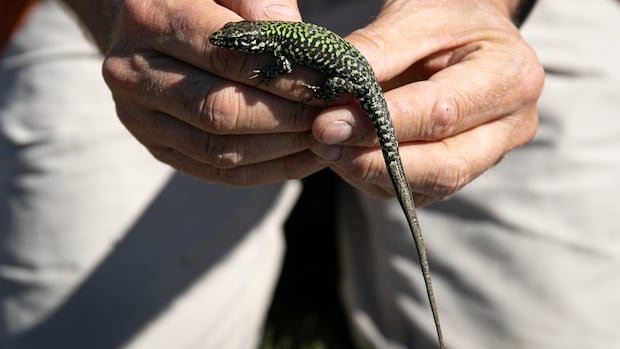

Tracy Menzies had been in a battle against slugs in her backyard garden, but this year, she celebrated the success of her beautiful strawberries. The reason behind the decline in slug population seems to be the invasive European wall lizard, rapidly spreading across regions and devouring various creatures, including slugs.
Living near the Gorge Waterway in Saanich, Menzies observed a surge in the number of wall lizards in her yard recently, indicating a potential connection to the reduced slug presence. Gavin Hanke, the curator of vertebrate zoology at the Royal B.C. Museum, estimated a significant population of European wall lizards in British Columbia, particularly on Vancouver Island, with concerns about their environmental impact.
Hanke emphasized the lizards’ swift proliferation and highlighted the adverse effects on local invertebrate populations, including baby garter snakes. The absence of official management programs to control their growth raised concerns among biologists, such as Nicholas Wong from the Invasive Species Council of B.C.
The origin of the lizard population in B.C. dates back to a deliberate release of a dozen lizards in 1970, following the closure of a roadside zoo in Central Saanich. The favorable climate conditions in Southern Vancouver Island have facilitated their rapid spread, with reports of their hitchhiking on various materials to expand their range.
These omnivorous lizards have been consuming insects, spiders, and even small vertebrates, posing a challenge to local ecosystems. Menzies expressed mixed feelings about the lizards, acknowledging their benefits in protecting her strawberries while also expressing concerns about their unchecked spread.
Hanke recommended maintaining a minimalist garden to deter the lizards, emphasizing the need for a collective effort to prevent re-infestation from neighboring properties. Despite the challenges, it is deemed too late to eradicate the lizards completely, with human activities playing a significant role in their proliferation and adaptation to altered habitats.
Hanke cautioned against relocating the lizards, as it could lead to further expansion of their territory. The curator also warned of the potential spread of the lizards to Washington state in the near future, underscoring the need for proactive measures to mitigate their impact.