

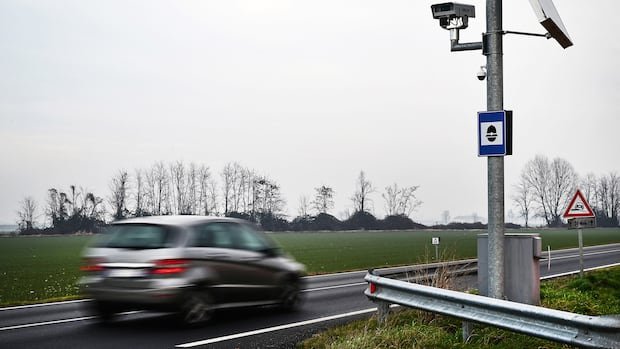

On a chilly day in 2024, residents in a suburban town close to Padua, Italy woke up to a surprising sight: a speed camera had been vandalized with an angle grinder, displaying the message “Fleximan is coming.”
Following numerous imitations of speed camera attacks, the name Fleximan has gained a legendary reputation in Italy.
Tom Roper, a British school proprietor residing in the area for 15 years, mentioned, “He was seen as a local hero. I had individuals contacting me, inquiring about Fleximan.”
Despite the flashy nature of Fleximan’s vigilante deeds, there exists a widespread consensus in Europe that speed cameras are effective and widely supported.
Jenny Carson, a project manager at the European Transport Safety Council (ETSC) in Brussels, Belgium, stated, “When you ask citizens, there is significant backing for enforcement. People want speeds to be decreased.”
Italy, boasting over 10,000 operational speed cameras, the most in Europe, serves as evidence of this inclination. A 2018 European survey revealed that nearly 70 percent of Italians backed stricter speeding regulations, despite around half admitting to speeding in the past month.
While Ontario Premier Doug Ford has taken a firm stance against speed cameras, labeling them a “cash grab” and contemplating a ban, the question arises: how has Europe managed to cultivate such extensive support for automated enforcement and establish a system that could potentially save numerous lives annually?
### The French Initiative
In 2002, following a series of notable traffic accidents, French President Jacques Chirac pledged to prioritize reducing traffic fatalities in his administration. Presently, France operates more than 2,400 cameras.
Laurent Carnis, a traffic safety expert at France’s Université Gustave Eiffel, highlighted that France offers a cautionary tale for Canada: garnering broad support for a similar system necessitates endorsement from the top.
Carnis emphasized the significance of political commitment in establishing the centralized mechanisms essential for issuing fines to drivers nationwide and beyond.
France, akin to other European nations, viewed speed cameras as both an educational tool and an enforcement measure. They utilized fixed cameras, clearly marked in advance, for driver awareness and mobile cameras to penalize offenders attempting to circumvent the system.
Across Europe, comparable systems have led to an average speed drop of 10 km/h or more and a reduction in road accidents ranging from 20 to 70 percent.
### ‘Similar to a Vaccine’
This aligns with outcomes in Canada, where municipalities observed average speed reductions exceeding 20 km/h near speed camera locations.
Carnis cautioned that while the immediate impact is significant, eliminating extreme speeding leads to a focus on minor infractions. This shift may contribute to growing opposition to speed cameras, as witnessed in France, where vandals have disabled up to 75 percent of the network.
Experts recommend governments adopt a selective and transparent approach in targeting individuals with speed cameras to maintain public support.
They stress the necessity of logical speed limits before implementing speed cameras, citing studies indicating that Canadian road designs often encourage high speeds.
Even with such measures, opposition to speed cameras persists. In Italy, where roads are narrow and congested, and cameras are identifiable on GPS, vigilante actions like Fleximan’s have prompted criticism from Deputy Premier Matteo Salvini, signaling a potential decline in political support for speed cameras in Europe.
Roper, the school owner in Italy, despite receiving speed camera tickets, supports the technology, emphasizing the need to control reckless driving behavior.