

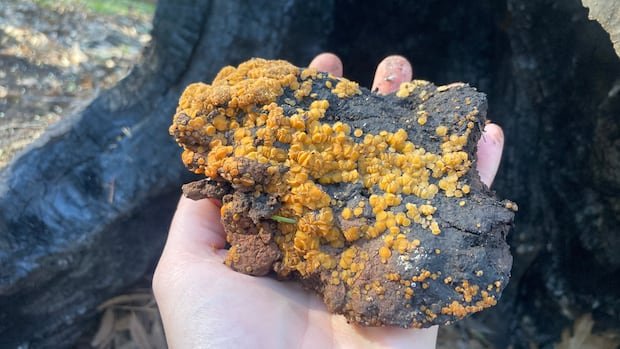

In the aftermath of a wildfire, a peculiar orange layer covers deadwood and the burnt forest floor, presenting a surreal landscape that appears to be still smoldering. However, rather than indicating further devastation, it signifies a new beginning: small fungi are establishing themselves in the aftermath.
Described as pyronema, these peachy-orange fungi are a type of pyrophilous fungi, meaning they thrive in fire-stricken environments and serve as nature’s initial responders following a wildfire. The study of these organisms and their role in fire recovery has gained significance as wildfires grow in size, intensity, and frequency due to climate change.
Pyrophilous fungi, believed to be dormant, have spores that remain inactive until triggered by a wildfire, according to Monika Fischer, a mycologist at the University of British Columbia (UBC) researching fungi’s post-fire impact. Traditionally, lightning-induced fires were predominant, selecting for adaptable organisms like pyrophilous fungi.
Recent years have witnessed unprecedented wildfire seasons, surpassing the historical average burn size, with 2023 marking a record-breaking year of 14.7 million hectares destroyed by fires. Understanding the post-fire environment, including the role of soils, fungi, and other organisms, becomes crucial in light of these extreme fire seasons.
These fire-loving fungi survive by being insulated in the soil, shielding them from surface temperatures as high as 1,000°C during fires. Fischer’s research revealed that just three centimeters below the surface, temperatures reached 70°C during a controlled fire experiment.
Pyrophilous fungi play a vital role in post-fire recovery by consuming ash, carbon, and toxic byproducts, transforming them into spores and fruiting bodies. These materials then become nutrients for secondary responders like insects, mites, and bacteria, initiating the ecosystem’s recovery process.
Erosion post-fire poses a significant risk due to the loss of stabilizing vegetation and the formation of water-repellent waxy layers on the soil surface. Fungi, with their threadlike hyphae, assist in stabilizing the soil, reducing landslide risks and aiding in decomposing post-fire residues.
Research by Thea Whitman at UBC highlights the symbiotic relationship between fungi and plant communities post-fire, demonstrating their interconnected recovery process over time. Moreover, the potential commercial applications of fire-loving fungi in industries due to their pollution breakdown capabilities are being explored.
While the manipulation of these fungi for accelerated forest recovery remains untested, Fischer suggests that small controlled burns could enhance the fungi’s response to wildfires, acting as a preparatory measure for future fire events.
In conclusion, the role of fire-loving fungi in post-fire landscapes showcases nature’s resilience and adaptation mechanisms, offering insights into ecosystem recovery following devastating wildfires.