

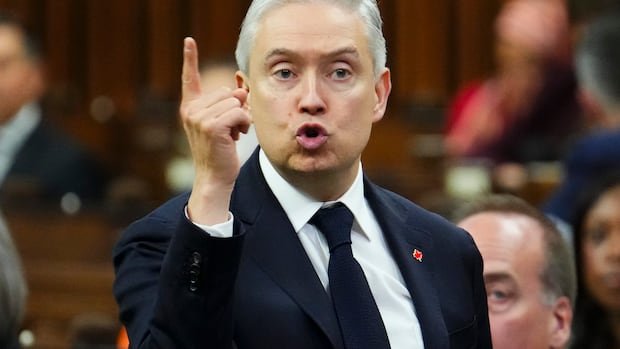

Finance Minister François-Philippe Champagne reaffirmed his deficit forecasts despite skepticism from Ottawa’s budget watchdog about the government’s ability to meet a crucial fiscal target. Parliamentary Budget Officer Annette Ryan released the office’s initial economic and fiscal update under her leadership, projecting that annual deficits would average $4.6 billion higher over the next five years compared to Ottawa’s spring economic update.
Ryan anticipates a slight decrease in the deficit for the current fiscal year to $71.8 billion, still surpassing Ottawa’s previous projection by around $6.5 billion. The budget office attributes the larger deficits to reduced income tax revenue and increased program expenses, partially offset by lower public debt charges.
One of the government’s fiscal goals is to maintain a declining deficit-to-GDP ratio in the coming years. The PBO’s outlook indicates a drop in the federal deficit-to-GDP ratio from 2.2% to 1.5% by 2030-31. However, stress-tested scenarios suggest a less than one percent chance of Ottawa achieving a yearly decline in the deficit-to-GDP ratio.
The PBO plans to release separate projections on the federal government’s aim to balance the operating side of the budget within three years. While the debt-to-GDP ratio is expected to rise over the next five years, the office estimates a 40% chance of a decline in this metric during the same period.
During a parliamentary finance committee meeting, Conservative MP Jasraj Hallan criticized the PBO’s report as scathing, challenging the government’s claims of fiscal sustainability. Minister Champagne defended the government’s projections, emphasizing the importance of reducing deficits to restore fiscal discipline.
The PBO’s updated economic forecast shows a slight downgrade compared to its previous outlook in September 2025. Real GDP is projected to increase by 1.1% this year and 1.6% next year, slightly lower than earlier projections. The office’s growth estimates align closely with private sector forecasts used in the government’s spring update, assuming the continuity of all current tariffs between Canada and the United States.
While recent reports of a second consecutive economic contraction have sparked discussions on Parliament Hill, many economists resist labeling the situation as a recession. The Conservatives blame the Liberal government for what they term a “full-blown recession,” contrasting Prime Minister Mark Carney’s view that federal policies are paving the way for long-term growth.
Champagne evaded direct questions about whether Canada is in a recession, focusing on the OECD’s positive projections and increased business investments as indicators of the economy’s resilience. Hallan criticized the minister for avoiding the question repeatedly.