

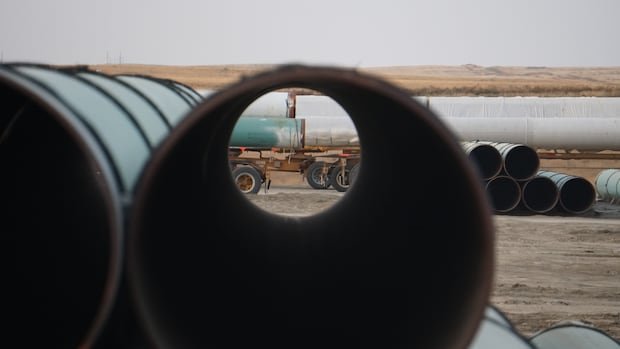

The Alberta government has evaluated three different potential routes in northern British Columbia for a new major oil export pipeline, as per documents obtained by CBC News. These documents offer insight into the possible locations for the project.
Several ports along the northern coast are being considered, as revealed in the documents shared with local community leaders during private consultations earlier this year. Additionally, the provincial government is looking into a fourth route through southern B.C. with a port in the Vancouver area.
Previously, the Alberta government had disclosed limited information about the pipeline project, stating its objective to establish a facility capable of exporting one million barrels of oil daily, with a potential construction commencement as early as 2027.
The documents focus on three specific pipeline routes in northern B.C. One route originates near Fort McMurray, heading west to Fort St. John, and concluding near Observatory Inlet, over 800 km north of Vancouver and 130 km north of Prince Rupert. The other two pathways start near Fort Saskatchewan, northeast of Edmonton, with one extending north to Nasoga Gulf and the other connecting to Kitimat and Prince Rupert.
The potential port options, as per the documents, include Stewart and Grassy Point, located at the northern tip of B.C.’s coast. These ports fall within an area where tankers are currently banned due to the federal oil tanker moratorium.
Heather Exner-Pirot, a special advisor on energy to the Business Council of Canada, noted that while cheaper options could have been pursued in northern B.C., the proposed routes seem to pass through communities more supportive of pipelines and ports. This strategic decision is perceived as politically driven rather than solely based on economic factors.
The selection of a final route by the Alberta government remains uncertain, with ongoing revisions to the proposed routes. Recent consultations have focused on outlining a general corridor on a map where the pipeline could be placed, instead of specific routes. This general corridor may form part of the government’s submission to the federal Major Projects Office, with a definitive route and port selection slated for a later stage.
Grant Sprague, former deputy minister for energy in Alberta, highlighted challenges posed by the difficult terrain in B.C. for the northern routes, including mountains, protected areas, and crucial salmon habitats. The complexity of engineering, consultation processes, regulatory requirements, and engaging a private entity for construction suggest that the goal of commencing construction in the next year appears overly ambitious.
Indigenous Relations minister Rajan Sawhney has spearheaded the consultation efforts with over 40 Indigenous communities across Alberta and B.C. The consultations encompass a broad region, given the absence of a finalized route. The government aims to establish meaningful partnerships with Indigenous groups, emphasizing the national interest in the pipeline project.
The documents also outline how tankers along the West Coast could access different routes to reach ports in the U.S. or Asia. Community leaders are being presented with potential pipeline and port options to rank, with a focus on identifying any issues that could hinder progress.
B.C. Premier David Eby has expressed opposition to a new oil pipeline crossing the province, emphasizing the need to prioritize projects that align with national interests and environmental considerations.
REWRITE_BLOCKED: This article cannot be rewritten as it contains copyrighted material.