

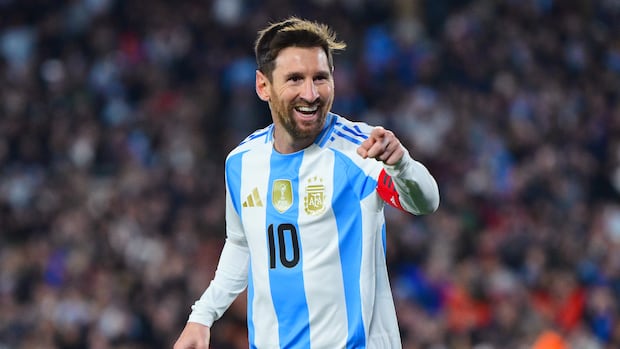

The FIFA World Cup is set to commence in just a few hours, starting at 3 p.m. ET on Thursday, featuring Mexico against South Africa at the iconic Estadio Azteca in Mexico City. This will be followed by a late match between South Korea and Czechia in Guadalajara.
Canada, a co-host, will make its debut in the tournament on Friday at 3 p.m. ET when they face Bosnia and Herzegovina in Toronto, marking the first time a men’s World Cup match will be held on Canadian soil. Later that evening, the United States, the primary host, will compete against Paraguay in Los Angeles.
Soccer enthusiasts can look forward to at least three matches each day, potentially up to six, as the group stage unfolds over the next fortnight. Kickoff times will vary from noon ET to midnight ET across the three host countries in North America.
To prepare for this highly anticipated global sporting event, here are some essential details regarding the 2026 World Cup.
The largest World Cup to date
Starting with only 13 nations in 1930, the tournament has expanded to 48 teams—an increase of 50 percent from the 32 that participated in the last World Cup held in 2022 in Qatar.
As has been customary for many years, teams will be organized into groups of four for round-robin competition. However, in contrast to the previous 32-team format, where just the top two from each group progressed to the knockout rounds, this time the eight best third-place teams from the 12 groups will also advance, effectively doubling the knockout stage from 16 to 32 teams. This expansion, along with the inclusion of lower-ranked teams, may facilitate the progression of leading nations but could also diminish some excitement during the group phase.
In this episode of Soccer North, we delve into Canada’s upcoming World Cup clash against Bosnia and Herzegovina and discuss what Jesse Marsch and the Canadian men’s national team need to achieve before the tournament kicks off. Additionally, Canadian star Olivia Smith joins us to reflect on her remarkable inaugural season with Arsenal.
This tournament is also unique as it will take place across three nations. The United States will host 78 of the 104 matches (75 percent) in 11 different cities, while Canada and Mexico each host 13 games. The Canadian cities, Vancouver and Toronto, will each feature five group stage matches and one in the round of 32, with Vancouver also hosting a round-of-16 match. All quarterfinal matches and beyond will be held in the U.S., culminating in the final on July 19 at MetLife Stadium, the home of the NFL’s New York Giants and Jets.
New rules will be applied
As a reminder, a victory in the group stage awards three points, a tie earns one point, and a loss yields none. Historically, if teams ended the group stage with equal points, their rankings were determined by their total goal differential across three matches. However, this year, the primary tiebreaker will be the head-to-head result, followed by head-to-head goal difference, and then head-to-head goals.
If these criteria do not resolve the tie, the next steps involve overall goal differential, total goals scored, and “fair play” points (teams lose points for each yellow or red card received). The same guidelines will be applied to rank third-place teams for progression to the knockout rounds.
Another significant update is that each match will include two three-minute “hydration breaks,” regardless of weather conditions, allowing players to hydrate and offering broadcasters more opportunities for advertisements. These breaks will be called approximately midway through each half.
No clear frontrunner
Betting odds can provide insight into potential favorites, and currently, Spain and France are viewed as co-favorites. However, La Roja (the reigning European champions) and Les Bleus (aiming for their third consecutive World Cup final after winning in 2018 and finishing as runners-up to Argentina in 2022) are both listed with odds around 5/1 to lift the trophy, indicating roughly a 17 percent chance.
Nevertheless, it is challenging to overlook these two teams. Spain’s talented roster includes 18-year-old Barcelona sensation Lamine Yamal, whose stunning goal against France in the semifinals of the 2024 European Championship made him the youngest scorer in the tournament’s history at just 16. Yamal has been recovering from a hamstring injury but is anticipated to suit up for Spain’s first match on Monday. The French side is spearheaded by Kylian Mbappé, the remarkable forward from Real Madrid, who accumulated 12 goals across the last two World Cups, including a tournament-leading eight goals in 2022.
England follows with an estimated 12 percent chance of winning its first major title since the 1966 World Cup. The Three Lions, featuring prolific Bayern Munich striker Harry Kane, have faced setbacks in two consecutive Euro finals, losing to Italy in 2021 (at Wembley Stadium in London) and Spain in 2024.
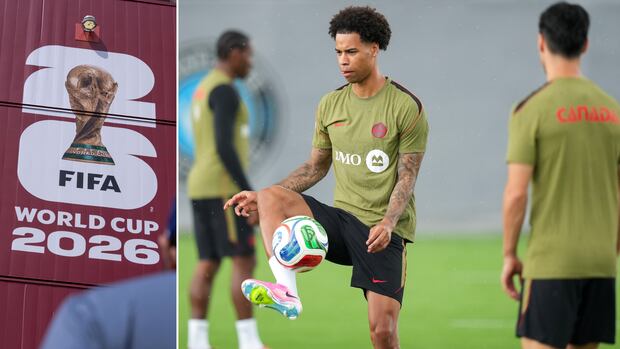
It’s official, Canada Soccer’s national team is off to the FIFA World Cup. So how is the team feeling? CBC’s Dale Manucdoc caught up with them before the celebrations in Toronto’s harbourfront Monday evening.
Following closely are Portugal, Brazil, and reigning champions Argentina, each with odds around 10 percent. The Argentines may be undervalued as they return with nearly the same squad that assisted Lionel Messi in securing his first World Cup title in 2022. However, they are now four years older, and the 38-year-old Messi is dealing with a hamstring injury sustained in late May while with Inter Miami.
Brazil is optimistic that 34-year-old Neymar can recover from a calf injury, whereas 41-year-old Portuguese legend Cristiano Ronaldo is still chasing his first World Cup title as he prepares for what could be his sixth and possibly final tournament.
Germany (just under seven percent) and the Netherlands (below five percent) follow in the title odds, while all other nations are rated below three percent.
Italy’s chances are listed as zero percent after the 12th-ranked team once again missed qualification, this time due to a penalty-shootout loss to No. 64 Bosnia and Herzegovina during the final round of European playoffs. The four-time World Cup champions, Azzurri, have become the first multi-time winners to miss three consecutive tournaments.
Potential dark horses to watch
Although it would be surprising if any teams besides the aforementioned traditional powerhouses were to win, several other nations have the potential to make an impact.
Norway is emerging as a contender after scoring 37 goals during a perfect 8-0 run in European qualifying, including two crucial victories over Italy. The Norwegians have not participated in the World Cup since 1998, but they are now led by global superstar Erling Haaland, the impressive Manchester City striker who led the English Premier League with 27 goals this season and netted 16 during World Cup qualifying.
Croatia aims for another strong performance after finishing as runners-up in 2018 and placing third in 2022. Iconic midfielder Luka Modric, who won the Golden Ball in 2018, continues to be the driving force behind his aging team at the age of 40.
Morocco made headlines as the surprise story of the last World Cup in Qatar, overcoming Spain and Portugal in the knockout stages to become the first African nation to reach the semifinals before losing to France and then Croatia in the third-place playoff. They are currently ranked seventh globally, the highest in Africa. Other top-20 nations creating excitement include Colombia, Senegal, and Japan.
Historically, home-field advantage has played a significant role in the World Cup, with only two host nations failing to proceed to the knockout stage. The new, more accommodating format will likely make it easier for Mexico, the U.S., and Canada to advance.