

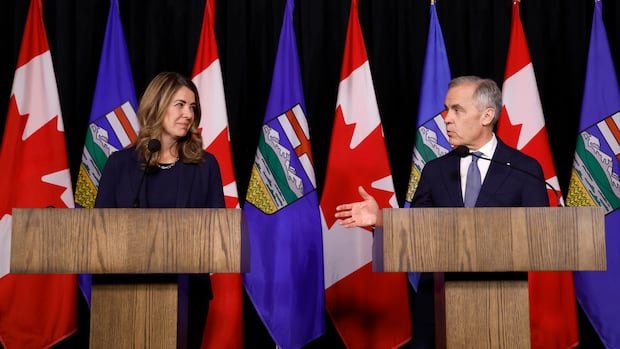

After Prime Minister Mark Carney and Alberta Premier Danielle Smith inked a significant energy deal that could pave the way for a new oil pipeline, stakeholders from government and industry are discussing their anticipations for the future.
The agreement outlines a strategy for Alberta to elevate its effective industrial carbon emissions price to $130 per tonne by 2040, with a headline price of $140 by that year, surpassing the current frozen price of $95 per tonne.
In return, Alberta will present a proposition for a fresh oil pipeline to Carney’s Major Projects Office by July 1. The federal administration indicates it will seek to designate the pipeline as a project of national interest by Oct. 1.
During an interview on CBC’s “Rosemary Barton Live,” Intergovernmental Affairs Minister Dominic LeBlanc stated that the pipeline’s construction is contingent on proceeding with the Pathways project, which involves carbon capture, utilization, and storage.
Alberta’s Social Services Minister Jason Nixon suggested that both projects do not necessarily have to progress simultaneously but affirmed a commitment to advance with both phases of the agreement.
The Alberta government has mentioned that if all goes as planned, the design and construction of the pipeline could potentially begin as early as Sept. 1, 2027, pending factors like support from the B.C. government and B.C. First Nations.
B.C. Premier David Eby, a vocal opponent of a new pipeline to the coast, criticized the federal government for potentially endorsing a secessionist referendum in Alberta.
Industry leader Adam Waterous expressed mixed sentiments about the agreement, acknowledging the reduced resistance to a new pipeline while highlighting challenges posed by the heightened carbon price.
The Oil Sands Alliance, representing major oilsands companies, noted that the agreement brings clarity on the industrial carbon tax but adds uncompetitive costs to Canada’s industry.
Concerns have been raised by environmentalists regarding the impact of the agreement on Canada’s climate targets established by former Prime Minister Justin Trudeau.
The involvement of a private proponent in the project remains uncertain, with Alberta signaling its willingness to act as the proponent in submitting the proposal.
Overall, the agreement has sparked debates among various stakeholders, with differing views on its implications for Canada’s energy sector and environmental commitments.