

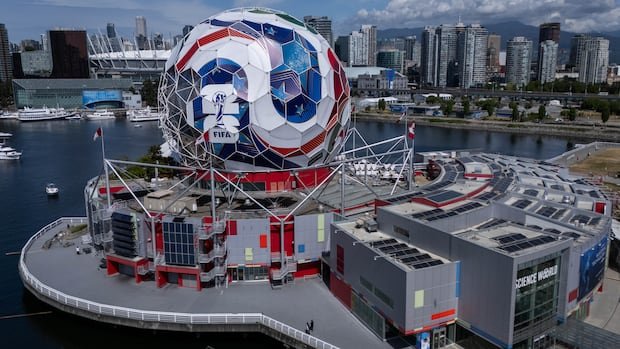

The provincial government of British Columbia anticipates enduring economic advantages from Vancouver’s hosting of seven FIFA World Cup matches. However, while the government foresees substantial gains, experts in sports economics suggest that the actual benefits may not be as significant as projected.
Moshe Lander, a sports economist and senior lecturer at Concordia University in Montreal, emphasized that the academic consensus leans towards skepticism regarding the purported benefits of hosting major sporting events like the FIFA World Cup. The estimated costs for staging the seven matches in Vancouver range between $685 million and $729 million, with expected revenues and contributions falling between $595 million and $615 million, inclusive of a substantial federal contribution of $216 million.
The government’s projections indicate that the FIFA World Cup matches in Vancouver could draw one million additional out-of-province visitors, generate approximately $1 billion in added GDP for British Columbia, and yield over $200 million in various provincial tax revenues from 2026 to 2031. The economic impact estimates were formulated using modeling conducted by B.C. Stats, the provincial government’s statistical agency, with data inputs from B.C. Stats, Statistics Canada, and Destination B.C.
Research on past large-scale sporting events, such as the Olympics and previous World Cups, reveals that profitability for host cities and governments is rare. Among the World Cups held between 1966 and 2018, only one event, Russia 2018, managed to generate a profit, while the majority ran deficits due to high costs and limited revenue streams.
Critics argue that the primary revenue sources from events like the World Cup, such as broadcast rights and sponsorships, largely benefit organizations like FIFA rather than the host countries. Significant expenses, particularly for venue construction, infrastructure, and security, often outweigh the financial gains for host cities like Vancouver. Despite optimistic projections, the long-term economic impact on tourism and local businesses remains uncertain, as evidenced by past experiences with events like the 2010 Winter Olympics in Vancouver.
The modeling approach adopted by the B.C. government does not factor in displacement effects, where existing tourist spending may be diverted by the influx of soccer fans during the World Cup. While the government focuses on new spending by out-of-province and international visitors, critics argue that the true economic impact may be overstated without considering the potential shift in consumer behavior.
In conclusion, while the FIFA World Cup may attract considerable attention and visitors to Vancouver, the actual economic benefits remain a topic of debate among experts in the field of sports economics. Despite the government’s optimistic outlook, the historical context of hosting large sports events suggests that the true financial impact on host cities may not align with initial projections.