

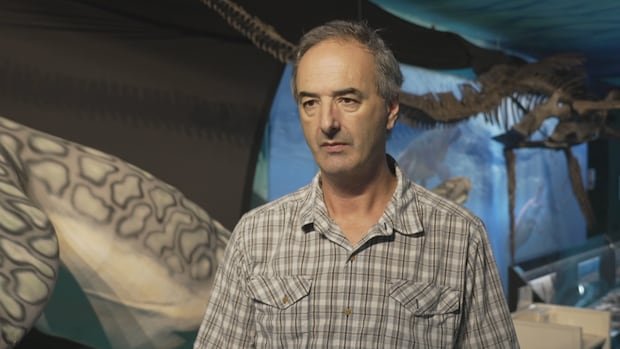

The Canadian Fossil Discovery Centre in Morden, Manitoba, has unveiled its latest exhibit showcasing the Styxosaurus, a long-necked plesiosaur from the Cretaceous period. The exhibit features reconstructions of the ancient marine reptile, with the original bones discovered in 1983 at North Cox farm near Miami, Manitoba. Using 3D printing technology, over 400 bones were printed and assembled to recreate the full skeleton, a first for the museum. Artificial intelligence was also utilized to create a realistic sculpture of the Styxosaurus.
The Styxosaurus, which could grow up to 12 meters in length and weigh over 4,000 kilograms, roamed the Western Interior Seaway, an ancient sea that once divided North America. Known for its long neck and sharp, conical teeth, the plesiosaur was a formidable predator. Visitors, like twelve-year-old Jorja Doerksen, marveled at the exhibit, highlighting the uniqueness of the creature and the discovery’s local significance.
Doerksen, fascinated by dinosaurs and ancient creatures, expressed her enthusiasm for the exhibit and the opportunity to suggest a name for the Styxosaurus. The museum encourages visitors to submit name ideas, following the tradition of giving specimens nicknames, such as “Bruce the mosasaur.” A prize will be awarded to the person whose suggested name is chosen for the Styxosaurus exhibit. Doerksen proposed the name “Apollo,” drawing inspiration from Greek mythology, as the Styxosaurus is named after the River Styx.