

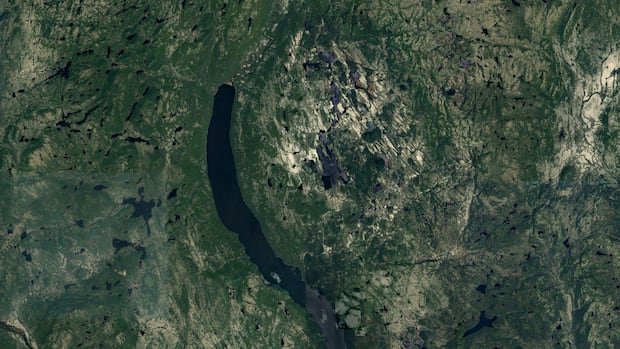

Amateur stargazer Joël Lapointe chanced upon what seemed like a suspicious depression in Quebec’s Côte-Nord region while exploring with his Google Maps cursor in 2024. In the midst of planning a camping trip, he unexpectedly came across what experts have recently verified as a previously unknown meteor crater dating back 390 million years.
Describing it as an exhilarating find, Gordon Osinski, a planetary geology professor at Western University and part of the team that confirmed the crater by physically investigating the site in 2025, expressed his excitement. Osinski, the founder of Impact Earth, a platform devoted to authenticated impact sites, often receives numerous emails from the public reporting potential new craters, many of which turn out to be false alarms. Reflecting on the discovery, Osinski emphasized the unpredictability of such findings, noting that even though most reports may not pan out, there is always the chance of a surprising discovery.
Osinski is scheduled to present the team’s research abstract at the upcoming annual congress of the Meteoritical Society in Germany. The society is an international organization dedicated to advancing research in planetary sciences.
Following Lapointe’s headline-grabbing discovery in 2024, Osinski and Jérôme Gattacceca, a geologist at the European Centre for Research and Teaching in Environmental Geosciences, embarked on a challenging expedition to the crater. Over a span of five days, the team collected photographs and samples to analyze in labs located in France and Ontario.
Describing the journey as one of his toughest field expeditions to date, Osinski highlighted the rugged and overgrown terrain they navigated. The team encountered difficulties when their float plane had to drop them off 50 meters offshore, necessitating a quirky gear-wading trek to the shore.
The team’s exploration led to the discovery of impact melt rock formations, which Osinski explained are generated by the intense heat and pressure of an impact event. Despite initial skepticism about finding such evidence in the eroded crater, they found striking examples that left Osinski amazed. Additionally, the team sought out shatter cones, distinctive rock formations indicative of impact craters or nuclear bomb testing sites, which they successfully identified during the mission.
Through the field research, the team gathered samples of rocks formed during the impact, allowing them to ascertain the crater’s age at 390 million years, a geological timeframe considered average.
Gattacceca described the discovery as a “remarkable lesson,” emphasizing that Earth, despite extensive study, still conceals surprises that continue to captivate researchers. Lapointe, in an email to Radio-Canada, expressed his joy upon learning of the confirmation of the crater’s existence, highlighting the rarity of an ordinary citizen stumbling upon a 390-million-year-old crater. He commended the selection of the crater’s name, Uhackatik, chosen in consultation with the Innu Council of Ekuanitshit, encouraging everyone to heed their intuition and observations, regardless of their area of expertise.