

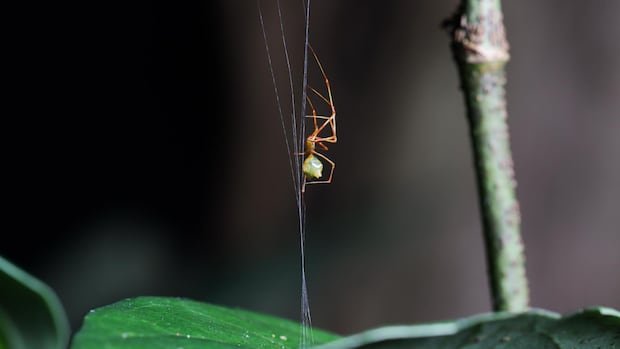

A newly identified spider species in the tropical rainforests of Australia has amazed scientists with its unique hunting method of propelling prey through the air using a silk trap equipped with a spring mechanism. The spider, dubbed the “ballista spider,” constructs a cone-shaped snare to launch green tree ants into its web, as detailed in a study recently featured in the journal Current Biology.
Ajay Narendra, a biology professor at Macquarie University in Australia and a key researcher in the study, expressed awe at witnessing the spider’s behavior. Belonging to the Propostira genus, this spider is yet to be officially classified with a species name.
The initial observation of this spider was made in 2022 by researcher Greg Anderson, who witnessed a green tree ant being flung into a web in a remote rainforest on Queensland’s Cape York Peninsula. Subsequent investigations by a team from Macquarie University involved using high-speed cameras to document the spider’s hunting method over a 10-day period in 2023. These spiders, measuring between three to five millimeters in length, are strictly nocturnal and spend daylight hours concealed under leaves before emerging at dusk to construct intricate traps below their primary webs.
The spiders employ a meticulous process to set their traps, involving the attachment of silk tension lines to a lower anchor point, such as a leaf or branch, which are then formed into a cone structure and wrapped with finer silk. Green tree ants are lured to the trap by a particular silk strand, and when they bite it, they become ensnared. The tension stored in the trap is eventually released, launching the ant into the air and straight into the waiting predator’s web.
Narendra believes that this hands-off hunting approach is an evolutionary strategy to capture green tree ants, known for their collective strength, without direct confrontation. Further research is planned to investigate the spider silk and potential pheromones used in targeting these specific prey.
The study has attracted interest from Saad Bhamla, an associate professor at the University of Colorado-Boulder’s BioFrontiers Institute, who speculates on the spiders’ prey targeting mechanism. He suggests that the vigilant nature of green tree ants might prompt immediate action upon detecting any foreign presence in their vicinity.
The remarkable launching speed of the ballista spider exposes the trapped ants to significant G-forces, surpassing those experienced by jet pilots. This forceful hunting tactic distinguishes the ballista spider from other species, like the slingshot spider, which employs a similar strategy but in a more active manner.
Bhamla highlights the efficient energy storage mechanism in the ballista spider’s silk trap, enabling it to launch prey with precision and force while maintaining a safe distance. The ongoing discoveries in nature continue to captivate researchers, indicating the vast unexplored realms of the natural world.