

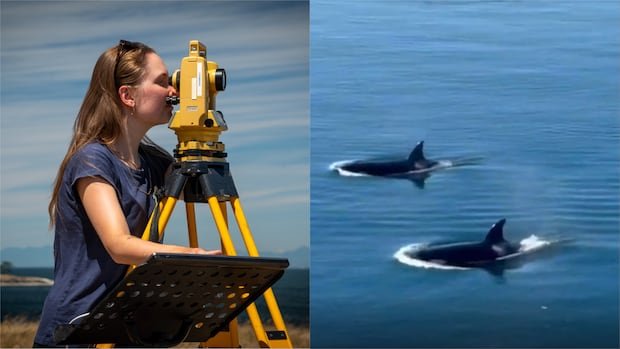

Whales are facing mortality in the waters of British Columbia due to various reasons like collisions with vessels and disruptions in their food search caused by ship noise. Instances such as a Sea-Doo hitting a grey whale off Vancouver in May, a humpback whale struck by a whale-watching boat last October, and another humpback whale struck by a B.C. Ferries vessel a month earlier, resulting in a dead whale washing up, are becoming more frequent. This trend is expected to escalate with the surge in ferry traffic and the Canadian government’s efforts to increase shipping to Asia through the same waters.
To address this issue, two British Columbia organizations are taking action. One of them is HALLO — Humans and Algorithms Listening for Orcas, an initiative launched by Simon Fraser University. The project aims to mitigate ship noise to enable the endangered southern resident killer whales to locate food in the region.
Lauren Laturnus, a biology master’s student at SFU, is involved in tracking whales in the Salish Sea and monitoring vessel activities from East Point on Saturna Island. By spotting whales, she provides reports to the Ocean Wise Whale Alert System, which notifies commercial mariners in real-time to adjust their speed or course.
Around 100 volunteer citizen scientists have also been trained to observe whale movements around Saturna, Pender, and Mayne Islands, sharing their findings with the Whale Alert System. The HALLO project’s primary objective is to create a peaceful environment for southern resident killer whales to feed without disturbance from vessel noise, which is crucial as these whales heavily rely on sound to navigate their surroundings.
Southern resident orcas are classified as one of Canada’s most critically endangered marine mammals, with approximately 74 remaining in British Columbia’s waters, excluding a new calf. Their main food source, the dwindling chinook salmon, is predominantly found in the Salish Sea, a prominent shipping route in North America.
Efforts are underway to enhance protections for these whales, with HALLO collaborating with the W̱SÁNEĆ Marine Guardians, an Indigenous-led initiative focusing on monitoring and conserving the marine ecosystem in the Salish Sea. Through the partnership, hydrophone recordings are analyzed by biologist Rachel Fairfield Checko to identify whale species, complemented by traditional knowledge from First Nations to advocate for improved whale safeguards from the federal government.
Moreover, experts emphasize the urgent need for enhanced safeguards for humpback whales globally, as vessel strikes claim an estimated 20,000 whales annually, predominantly large species like humpbacks, greys, blues, and fins. Glenn Jones, founder of Reach Technologies Inc., has developed an optical technology utilizing a multispectral camera system to detect objects in the water, including whales. The innovation aims to provide early detection of whales for commercial vessels and ferries, allowing them to adjust their routes and prevent collisions with marine mammals.
Jones envisions deploying this technology on commercial ships to identify whales from a considerable distance, providing ample time for vessels to maneuver and avoid potential collisions. By respecting marine life and implementing proactive measures, stakeholders aim to ensure the safety and preservation of whales in British Columbia waters.