

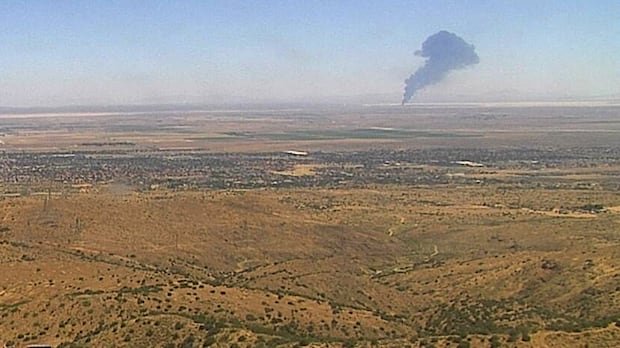

A B-52 bomber crashed and caught fire shortly after taking off from a U.S. Air Force base in Southern California’s Mojave Desert, resulting in the tragic deaths of all eight individuals on board, as confirmed by military officials. The incident occurred around 11:20 a.m. local time during a routine test mission at the base, located north of Los Angeles. Aerial footage depicted the severe aftermath, showing little remaining of the aircraft, with black smoke billowing from the charred desert area near a runway, alongside emergency response vehicles.
Among the deceased were government contractors and military personnel, including two Boeing employees, as verified by the aircraft manufacturer. After examining crash footage, Col. James Hayes, the deputy commander at Edwards Air Force Base, announced at a press briefing that there were no survivors, lamenting the loss of “eight great Americans” and emphasizing efforts to notify their families. The cause of the crash remains unknown, with an estimated six-month investigation period ahead, though it was disclosed that the B-52 was involved in the “radar modernization program.”
The Boeing B-52 Stratofortress, a long-serving bomber introduced in 1955, is designed to deploy both conventional and nuclear armaments and has seen action in various U.S. military engagements from Vietnam to Iran. In 2025, a B-52 equipped with an upgraded radar system arrived at Edwards for testing purposes. The modern active electronically scanned array (AESA) radar replaced the outdated system to enhance effectiveness, though it is unclear if this was the same aircraft involved in the recent crash.
Edwards Air Force Base, situated approximately 160 kilometers north of Los Angeles, serves as a hub for U.S. air force aircraft testing and development activities. The 412th Test Wing oversees the base operations, conducting assessments on all air force aircraft, weaponry, software, and components before acquisition and throughout their service life. Notably, the base witnessed Chuck Yeager’s historic breaking of the sound barrier in 1947.
Following the crash, the airfield was temporarily closed, diverting inbound flights, but resumed operations later in the day. Visitor passes were halted as emergency crews extinguished the blaze, with the cause of the incident still under investigation. U.S. Air Force Secretary Troy Meink expressed deep sorrow over the fatalities, emphasizing the dedication of Airmen, civilians, and contractors to advancing the air force’s mission.
Aviation safety expert Jeff Guzzetti speculated that a flight control malfunction might have contributed to the swift crash after takeoff, highlighting the complexities of testing new equipment on aircraft. Despite the air force’s extensive experience with B-52 bombers, incorporating new technologies during test flights can present unforeseen challenges, underscoring the inherent risks associated with such operations.
Noteworthy fatalities in recent air force accidents include an instructor pilot in 2024, an air force ROTC cadet in 2022, and two pilots in 2021, each incident involving distinct circumstances. The B-52 crash in California marked the first since a similar occurrence in Guam in 2016, where all crew members survived.
[Photo Caption: An aviation enthusiast observing a U.S. air force B-52 Stratofortress taking off from Fairford, England, in March.]
[Photo Credit: Leon Neal/Getty Images]