

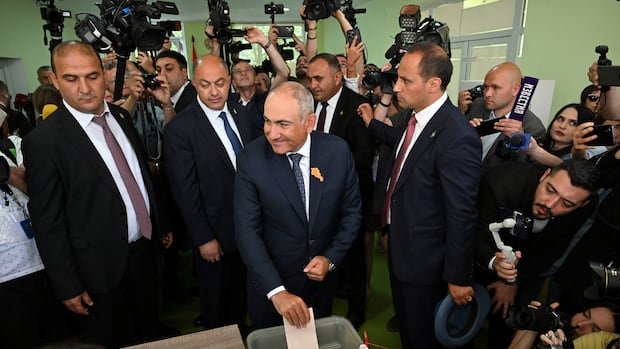

Armenia’s ruling Civil Contract party emerged victorious in an election considered a crucial test of its management of a peace agreement with Azerbaijan and its pivot towards Western nations, despite what international election monitors deemed as direct meddling and coercion by Russia. Prime Minister Nikol Pashinyan’s party secured 49.8% of the votes following Sunday’s election, sufficient to attain a parliamentary majority within Armenia’s electoral framework, as confirmed by the Central Election Commission (CEC) on Monday. The election results, based on a robust voter turnout of nearly 59%, also indicated a stronger-than-anticipated performance by the two primary pro-Russian opposition factions, collectively garnering 31% of the votes and poised to enter parliament.
International election watchdogs highlighted Russia’s endeavors to influence the election’s outcome in the lead-up to the voting process. Edita Estrella from the Parliamentary Assembly of the Council of Europe observer mission criticized Russia for exerting unprecedented pressure through public threats and trade measures to significantly impact the election results. She emphasized the condemnation of such blatant interference by European Parliament members.
In response, Russia accused Western nations of interfering in the electoral process and sided with Armenia’s opposition in alleging electoral irregularities. Russian Foreign Ministry spokeswoman Maria Zakharova cited a widespread desire in Armenian society for the continuous advancement of Russian-Armenian relations. This election marked Armenia’s first parliamentary poll since the 2023 conflict where Azerbaijan reclaimed Nagorno-Karabakh, a region with a predominantly Armenian population.
Pashinyan’s triumph is anticipated to bolster his endeavors to broaden Armenia’s alliances and trade partners beyond Russia, gravitating more towards Western countries. A pivotal aspect of this initiative involves finalizing a peace pact with Azerbaijan and normalizing ties with Turkey, an ally of Azerbaijan. While Pashinyan celebrated a “historic victory” and vowed to strengthen connections with both the West and Russia, certain opposition factions cried foul.
European Commission President Ursula von der Leyen extended congratulations to Pashinyan, affirming European support for Armenia’s democratic path towards closer ties with Europe. However, Pashinyan fell short of securing the requisite two-thirds majority in parliament to convene a constitutional referendum mandated by Azerbaijan as part of the peace agreement, aiming to reopen borders and resume trade with Turkey. Azerbaijan seeks Armenia to amend its constitution to dispel what it perceives as an implicit claim on Nagorno-Karabakh.
Zaur Shiriyev, a non-resident scholar at the Carnegie Russia Eurasia Centre, expressed uncertainty regarding Azerbaijan’s willingness to proceed with the peace process if Armenia fails to hold a referendum on constitutional amendments. He highlighted the potential challenges the Armenian government could face in such a scenario, emphasizing the complexities of aligning with the opposition on such a sensitive issue.
Opposition coalitions Strong Armenia and Armenia Alliance secured 23.2% and 9.9% of the votes, respectively, as per the CEC. However, Prosperous Armenia, a fourth party, did not meet the 4% threshold required to enter parliament. Election observers from the Organization for Security and Co-operation in Europe acknowledged the smooth conduct of voting in most regions but noted that the pre-election prosecution of opposition figures contributed to perceptions of biased justice.
Ahead of the election, arrests targeting the opposition, including parliamentary candidates for Strong Armenia, were reported. Samvel Karapetyan, the founder of the party, who campaigned for close ties with Moscow and is currently under house arrest, stated that over 700 individuals affiliated with the group had been detained. The Armenia Alliance, led by former pro-Russian president Robert Kocharyan, criticized Pashinyan’s premature victory assertion as an attempt to pressure the CEC and seize power, as reported by the Russian news agency Interfax.