

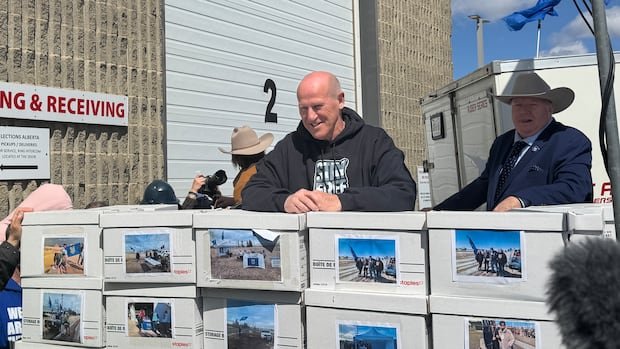

The Alberta government has announced its intention to challenge a ruling by an Alberta Court of King’s Bench judge that invalidated the approval of a petition for a referendum on Alberta independence. The decision by Justice Shaina Leonard has placed the fate of Stay Free Alberta’s independence petition, which claims to have amassed over 300,000 signatures, in uncertainty.
In a ruling issued on Wednesday, Justice Leonard determined that Elections Alberta’s chief electoral officer, Gordon McClure, erred in law by endorsing the second citizen initiative petition without considering a previous court judgment stating that separation would infringe on the treaty rights of Indigenous peoples. This led Leonard to conclude that there was a legal error, rendering the chief electoral officer’s decision unreasonable.
Premier Danielle Smith, speaking at an unrelated press briefing, expressed the government’s disagreement with Leonard’s ruling, stating that it would deprive over 300,000 Albertans of the opportunity to have their petition validated by Elections Alberta. Smith criticized the decision as legally incorrect and undemocratic, announcing plans to appeal it after consulting with the cabinet and caucus.
Justice Leonard also highlighted that the government, as the representative of the Crown, failed in its duty to consult with the Athabasca Chipewyan First Nation, Blood Tribe, Piikani Nation, and Siksika First Nation applicants. Chief Samuel Crowfoot of the Siksika First Nation emphasized the importance of treaties as ongoing agreements and urged the government to engage respectfully with First Nations during consultations.
The leader of the Athabasca Chipewyan First Nation, Allan Adam, called on Premier Smith to accept the court’s decision and demonstrate leadership by collaborating with First Nations to advance the country’s development. Similarly, Troy Knowlton, chief of the Piikani Nation, hailed the judge’s ruling as a significant triumph, stating that proceeding with an unconstitutional question would have jeopardized treaty rights.
Stay Free Alberta gathered signatures between January 2 and May 2, with the group’s leader, Mitch Sylvestre, delivering the petition to Elections Alberta on May 4. Sylvestre expressed confidence that Smith would allow a referendum to take place in the fall, emphasizing the desire of the signatories to participate in a vote on independence.
In response to Leonard’s decision, one of Sylvestre’s lawyers, Jeff Rath, criticized the ruling as incomprehensible and announced plans to appeal. He indicated that supporters of the separatist movement would acquire UCP memberships to pressure Smith into calling for a referendum.
Furthermore, the Alberta NDP Leader, Naheed Nenshi, urged Premier Smith to accept the court’s decision and cease efforts to proceed with the referendum. Leonard also denied an injunction request from the Sturgeon Lake Cree Nation, which alleged violations of Treaty 8 and increased racism and misinformation during the petition process.
The Sturgeon Lake Cree Nation’s lawyer, Orlagh O’Kelly, expressed disappointment with the ruling and mentioned that the Nation is evaluating potential next steps. Chief Sheldon Sunshine of the SLCN acknowledged the loss but highlighted the impact of raising awareness about treaty obligations and foreign influences through the case.
Smith and her cabinet ministers have voiced support for a sovereign Alberta within Canada while advocating for direct democracy. The premier has outlined nine referendum questions on immigration and constitutional changes for an upcoming vote on October 19. Previously, a pro-federalist petition led by Thomas Lukaszuk, former deputy premier of Alberta, received validation with over 400,000 signatures in December.