

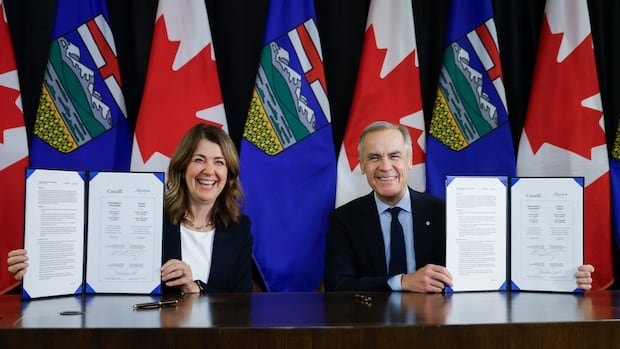

The federal and Alberta governments have reached an agreement on industrial carbon pricing, a significant policy aimed at reducing harmful greenhouse gas emissions in Canada. Sources indicate that Alberta’s effective carbon price is set to rise to $130 per tonne by 2040. An official announcement is expected before the week concludes, although the sources requested anonymity due to the confidential nature of the discussions.
Canada has a national carbon pricing system that applies to all provinces and territories, with the headline price scheduled to increase to $170 per tonne by 2030. Currently, in Alberta, polluters pay $95 per tonne under the existing carbon pricing mechanism. However, they can also acquire carbon credits from the market at a lower effective price, approximately $45 per tonne.
The carbon pricing system in Alberta for heavy emitters, known as Technology Innovation and Emissions Reduction Regulation (TIER), was outlined in the energy accord signed by both governments in November. This agreement stipulates that the carbon price should escalate to a minimum effective credit price of $130 per tonne.
Industry stakeholders emphasize the importance of establishing clear pricing structures to instill confidence in energy investments. This is particularly relevant to projects like the Pathways Plus carbon capture initiative, which was part of the memorandum of understanding between the governments.
Although there are a few outstanding issues to resolve, Prime Minister Justin Carney is tentatively scheduled to visit Alberta on Friday for the announcement alongside Premier Danielle Smith. Meanwhile, Carney is set to unveil a federal electricity strategy on Thursday with the goal of doubling the electricity grid by 2050.
Former Alberta finance minister Doug Horner views the carbon pricing agreement as a significant development benefiting both the province and the nation as a whole. The potential referendum on separatism in Alberta adds further significance to the negotiations, with proponents seeing this deal as a unifying force within the federation.
However, concerns have been raised by British Columbia Premier David Eby regarding the perceived preferential treatment of Alberta with a specialized federal carbon price. The move has sparked debates about competitiveness and equity among provinces.
The Canadian Climate Institute highlights the importance of robust industrial carbon pricing for achieving net-zero emissions by 2050. The current trading system allows emitters to earn and sell credits, but oversupply and low market value have hindered emission reduction efforts. The agreement to raise the credit price to $130 per tonne raises questions about the effectiveness of emission reduction strategies.
Negotiations over the timeline for carbon pricing have been a point of contention, with Alberta seeking a ceiling price until 2050 while Ottawa preferred it as a starting floor for incremental increases. A compromise has now been reached, paving the way for addressing other aspects of the MOU, including an oil pipeline, the Pathways project, AI computing capacity expansion, and enhanced interties with neighboring provinces.