

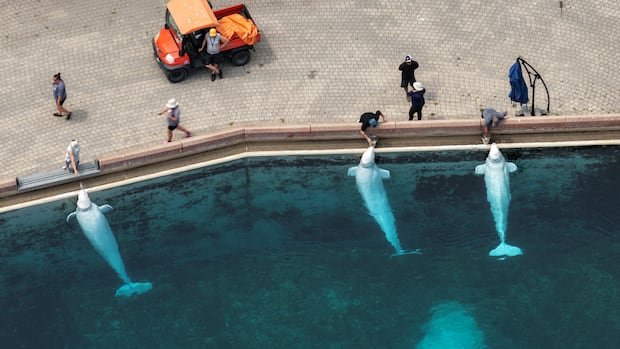

Earlier this month, the federal government greenlit a proposal that may see the 30 beluga whales currently residing at the closed Marineland in Niagara Falls, Ontario, relocated internationally to new facilities. Due to a law enacted in 2019 in Canada that forbids the keeping of whales, dolphins, and porpoises for breeding or entertainment purposes, the belugas are anticipated to be distributed among an aquarium in Spain and four in the United States.
Transporting these aquatic mammals, which can reach lengths of up to 4.5 meters and weigh over 1,900 kilograms, poses a significant logistical challenge. While specific details from the destination aquariums managing the rescue operation are still pending, insights from experts familiar with whale transport shed light on the process.
Firstly, paperwork and preparations play a crucial role. Although belugas do not require passports, the team involved would need permits from both the Canadian government and the recipient countries for the relocation. Decisions on where each beluga will be relocated would factor in their individual personalities, as assessed by trainers. Prior to the journey, the belugas must undergo a veterinarian’s assessment, bloodwork, and other health evaluations.
Practice is key in ensuring a smooth transition. Trainers typically spend months acclimating the belugas to the tools used to move them from their tank. Custom-made slings and stretchers are employed to lift the belugas out of their tank, with trainers encouraging them to explore and eventually enter the equipment. Familiarizing the belugas with the sling may take a couple of months, depending on each whale’s temperament.
On the day of travel, the belugas are lifted out of the tank using slings and placed in custom transport crates suspended on stretchers. These crates must provide ample space for the belugas to move comfortably while submerged in water. Padding inside the crate aims to minimize external noise that could distress the whales during transport.
The transport crate is then transported by truck to a cargo plane, accompanied by a crew of trainers and veterinarians to monitor the belugas’ well-being throughout the flight. Pilots are expected to maintain a low flying altitude to ensure the belugas’ comfort, mirroring conditions they encounter at sea level in the wild.
Upon arrival at the destination, the belugas are lifted by slings and cranes from the transport truck into their new aquariums. Quarantine procedures are implemented to safeguard the belugas’ health and prevent the spread of diseases. Trainers may also stay behind to impart their knowledge of the belugas’ behaviors to new handlers.
Releasing the belugas into the wild is deemed unfeasible due to geopolitical challenges, particularly for belugas originating from Russia. Given that many of the Marineland belugas were born in captivity and lack essential survival skills like hunting, reintroduction to the wild would be impractical. Their strong social bonds render them dependent on human care for survival.
Overall, the operation to relocate the Marineland belugas involves meticulous planning, practice, and specialized care to ensure a safe and successful transition to their new homes.